[ Previous ]   [ Next ]

Accurate translation

Dictionary

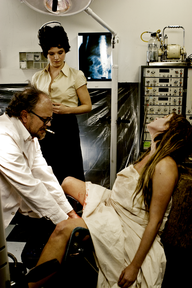
This morning a good friend of mine visited the gynecologist.
The scene took place in Amsterdam; they spoke Dutch to each other.
The gynecologist used the Dutch word “bips”.
The dictionary says that “bips” means “buttocks” or “bottom”. But I don’t think this is an accurate translation. I would say that “bips” comes close to the German word “Popo”.
I wonder how you can translate “bips” into English.

45 comments Last_comment
Hiney?
Han-Wen
Not bad.
There are various choices. But "bibs" is probably mostly used by adults as a semi-polite word.

"Behind" (from which "hiney" is derived) is probably a good choice and works in the USA and the UK. "Hiney" is very American.

"Bum" is another possibility (more UK than USA). "Butt" in the US.

In the context "bum" might be more fitting. A gynaecologist saying "bum" is a little strange. (What was the gynaecologist doing with her bottom? Had he lost his way?)

The word "botty" comes to mind. Though it is more a word used by adults towards children.

I hope the situation was innocent. I had a Dutch dentist once who told me to keep still or he'd have to use corporal punishment. His assistant didn't bat an eyelid. He drove a Ferrari - perhaps that explains it. (Or perhaps this explains the Ferrari.) In any case I never went back. I'm not very keen on novel techniques.
The gynecologist used the Dutch word “bibs”,

I would have thought he would have used the word voor-bibs?
http://www.sex-lexis.com/Sex-Dictionary/buttock
Shouldn't it be 'bips' instead of 'bibs'?
And in Flanders we use the beautiful word 'poep' as in 'Wat een mooi poepje heb jij.'
The gynecologist probably said something along the lines: 'Now, if you would move your 'bibs' a little more to the front of the chair, it will be easier for me to work.'

Gynecologists have to worry about their backs: women sometimes tend to retreat as far as possible (an understandable reflex), forcing the gynecologist to keep bending more and more over to the area of expertise.
(As a reaction to 'A gynaecologist saying "bum" is a little strange. (What was the gynaecologist doing with her bottom? Had he lost his way?)', by Carlos Dee.)
Carlos
“Bibs” is often used in (old-fashioned) children’s book. If you look up the books of the late Annie M.G. Schmidt you will stumble upon the word “bibs” now and then.There is something uncanny when an adult, especially a gynecologist, uses this word against a (young) woman. I’m not sure if you preserve the uncanniness with a word like “behind”. I wasn’t aware of the word “botty”. “Hiney” struck me as a reasonable choice.And you should never go to a dentist who has a Ferrari.
Hordijk
Exactly. Are you a gynecologist?
Master
One can only wonder what our respected Romanian master would make of all of this. Anyway, just bought some new socks and, indeed, last Monday I was at the gynaecologist (in a supporting role).
Mieke
Yes, it is "bips" not "bibs" -- thanks! I corrected the mistake.
Mr Grunberg
No, I'm not a gynecologist, but I have been an intern at that department for 8 weeks as part of my study medicine. There I quickly came to the conclusion that gynecology, although it certainly has his upsides , wasn't my natural habitat.
Interestingly, Google Translate provides more alternatives in English for 'Popo' then for 'bips'.
In this context however, 'voorbips' may have been the more logical term - see for reference http://www.youtube.com/watch?v=eE1dBqg5fAo :-)
Voorbips probably isn't what he meant. He literally wanted her to move her ass over the chair, more to the front, so he could take a look at the so-called 'voorbips'. No how do you say that politely to the woman in front of you? 'Even de bips naar voren schuiven' is pretty common lingo, I seem to recall, it doesn't really sound that uncanny to me. The problem is: you have to be clear, the patient needs to know she has to move her ass, but you ofcourse can't be too rude. Bips sounds fine to me.
"Tokhes" is another possibility. So far, "hiney" gets my vote.
I'd opt for "Tush"

tush 3 Pronunciation (tsh)
n. Slang
The buttocks.
Gynecolist
I've been wondering at what age a woman should start having "things checked" down there, every once in a while.
Hordijk
I find "bips" an uncanny word, but it isn't for nothing that I'm not a gynecologist.
batta
From 30 years of age every five year every female Dutch citizen receives a call for a cervical smear.

http://www.rivm.nl/bevolkingsonderzoeknaarbaarmoederhalskanker/onderwerpen/Uitnodiging/
Gat
Once, an assistant midwife told me to sleep in my "blote gat."
It isn't for nothing?
...is that an accurate translation for the Dutch ''het is niet voor niks, dat" ?
Allemagne
Think of Leonard Cohen's "The Law":
"That's all I can say, baby That's all I can say It wasn't for nothing That they put me away I fell with my angel Down the chain of command."
Hanny
I've also heard 25. I'll ask my doctor when I see her, I think she can even do it herself.
Arnon
I've only heard "bips" used very occasionally in everyday spoken Dutch. For some reason my daughter's (basisschool) teacher uses "bips" rather than "billen".

Both "hiney" and "tush" are good choices for the US. But they would sound strange to readers in the UK. (Especially if used in a Dutch setting.) One of the challenges of translation from Dutch to English is to find a sort of "mid-Atlantic" English that works in both the US and the UK. This isn't about spelling differences. It's about avoiding words and sayings that may be misunderstood or not understood at all by readers on the other side of the Atlantic.

I have come to the conclusion that my former dentist is probably a bdsm enthusiast. He was recommended by friend. I later heard she had had several trysts with him and had once even disappeared for three weeks to his "compound" in Bergen after a particularly energetic tiff with her husband.
Carlos
I believe most literary translators who translate into English strive for “mid-Atlantic English”. Even though it may alienate readers in the UK I would urge my translator to use the word “hiney” for “bips”, unless he comes up with a better word of course. US authors are not “translated” when their books are published in the UK, nor are most UK authors “translated” when their books are published in the US.Some Irish and Scottish movies come out with subtitles in the US, but that’s pure a matter of accent. While I was working as a waiter in Manhattan in the nineties I honestly believed that a Scottish couple I was serving was speaking Serbian to me.It’s my impression that an author like Coetzee writes by nature “a mid-Atlantic English.” Wouldn’t you say that Hollywood has made US English less alien to people in the UK?
bips
Arnon, there is this forum on which you can post these kind of questions. I like it.
http://forum.wordreference.com/
Mieke
I often think about the difference between the Flemish and the Dutch. It's one of those things that is difficult to put your finger on. But using the word "poep" for behind, is an obvious difference. Poep has a negative connotation for me. For example, while I have nothing against anal sex (I'm very liberal) I would never, ever, approve of having sex "in de poep", as the Flemish say, when they do so.
T.R.
'Poepen' as a verb for us means 'van bil gaan', it has no connection with anything anal or faeces. At the contrary , it's almost a loveword.
'Een poep' has a sweet ring too. My father's favorite when he saw a childrens buttom was:" Jij hebt een poepje om met sla te eten."
@T.R.
The once famous Barend Servet song ‘He ha ho wat moet ik poepen (waar is hier de plee ….)’ has a totally different meaning in Flemish and in Dutch, as Mieke said.
Arnon
I presume that JM Coetzee writes the English he speaks and thinks. In other words a sort of internationalized South African English. I notice that he avoids the use of the word "bakkie" - the ubiquitous South African word for "pickup truck". On the other hand he uses "veld". David Lurie "hires a room", rather than renting one, which is UK English.

I think this is not the problem however. A reader expects an English-speaking writer or persona to use a particular flavour of English. The problem is more the choice of English used in translation. It would be very strange for a character from Amsterdam or Bratislava to use upper-class British English, cockney or Southern Californian slang. I suppose, in the end, the English has to be as neutral as possible.

In my view, readability should be given priority over literal accuracy. Of course, some things will be lost. But it is possible to keep the flavour of the original in other ways.

I recently read the English translation of Houellebeque's "Plateforme". I was impressed that I did not feel I was reading a translation. Perhaps some of the allusions and references were lost - my French isn't good enough to read the original. But they would have been lost on me anyway unless extensive explanatory footnotes had been provided. In some cases, the translator has an easier job. For example, Beigbeder's "Windows on the World" is set in America except for the first-person parts about the author himself. I found Georges Perec's "La Vie mode d'emploi" ("Life: a User's Manual") to be almost unreadable in translation. While the original may be a hard read, the rather literal (reading) translation certainly didn't help.
Carlos
I agree with the last part of this statement. The first part of this statement troubles me a bit. Do we really know what the reader expects? In “Revolutionary Road”, the novel by Richard Yates, one of the main characters says after having had sex with a co-worker: “It was swell.” The word “swell” struck me as slightly outdated. A translator into Dutch is ill-advised to translate “swell” with let’s say “mieters”. The point is to avoid “fashionable words” because it’s these words that make a text often dated.In Coetzee’s “Slow Man” one of the characters speaks bad English, almost broken English; even this broken English is very neutral.You refer to dialect, which is indeed very hard to translate. But to come to the original question: I would say that’s it is very well possible for a gynecologist in Amsterdam to say in a book in English translation: “Move your hiney a bit.”Readability doesn’t always mean that you have to sacrifice accuracy.
T.R.
Ikzelf ben een West-Vlaamse, maar toch durf ik van mezelf nauwelijks te beweren dat ik het West-Vlaams nog beheers. Zeker ik gebruik nog het accent, maar het echte idioom ben ik kwijtgeraakt en dit vooral onder invloed van het geschreven Nederlands zoals ons dit op school wordt geleerd. Ook bij ons was 'Jip en Janneke' een klassieker. Daar leerden we woordjes zoals 'bips'. Volgens mij kun je enkel nog in het noorden van Frankrijk het zuivere, ongekuiste West-Vlaams horen. Daar werd het oraal overgeleverd zonder dat ze Nederlands leerden lezen. Tot in de jaren vijftig werd het in de landelijke gemeentes nog courant gesproken. Onlangs zijn ze in enkele schooltjes een project gestart waarbij enkel uurtjes les in het West-Vlaams wordt gegeven. Meer nog ,ze hebben nu ook een officieel schrift ontwikkeld, maar zelfs ik, als West-Vlaamse, snap er nauwelijks iets van.
Tabatha
Hm... Mister Grunberg, if you will: I beg to differ. I didn't mind 'swell' at all. Personally, I liked that it was right in the beginning and therefore sets the tone by 'taking you back'. The same way the language in Catcher in the Rye didn't bother me. As long as the themes aren't outdated. I'm thinking the themes may even have greater impact when we subconsciously realize nothing's changed 'since then'. Also, think The Hours. Or any of Cunningham's books for that matter, Specimen Days is set in three different periods with different tones, wording and rhythm. Oh and (and and!!) of course, Mitchell's 'Cloud Atlas' !! An interesting book to take a look at in terms of purposefully using/recrafting outdated language. http://www.noipo.org/index.php?id=224
Oh, that was strange - I didn't mean to address the above to myself.
Tabatha
You are jumping to conclusions, wrong conclusions. I didn’t mind the word “swell” at all.It struck me as peculiar word, especially in the context of the scene I mentioned above. Do you really believe that I take offense to peculiar words?On the other I hand I happen to know a woman who has a blog titled “it was swell” in which she writes mainly about romantic or less romantic encounters.Sometimes it’s a thin line between old-fashioned and ironic.Anyhow we were discussing translation, and that’s a slightly different matter. I gave the example of the word “swell” because it is a word that could get easily abused by a translator.In this case I would opt for “het was aangenaam” to keep the irony and to avoid the heavy-handedness of an outdated word.
Mister Grunberg, I see. Apologies, and thank you for elaborating.
batta
In Germany women are advised to go and see their gynaecologist once every year from the age of 20 (more often if their PAP results are abnormal).

Mine is a very nice woman who has a cosy on her tissuebox and gets all enthused about my inner organs every time she sees them. I haven't decided, yet, if I like being paid compliments on my ovaries, though.
Tabatha
'Cloud atlas' became in Dutch 'wolkenatlas' and I found it quiet unreadable (especially the first 100 pages), but if that has only to do with the (for me) bad translation I don't know yet.
My gynaecologist normally aks me to move my 'pelvis', no uncanniness here.
@Mister Grunberg, I've been thinking - "het was aangenaam" feels more distant and rational than the somewhat lethargic: "it was swell" would you agree? And less condescending. Indeed, translation is a complicated matter. How about: "geweldig, schat."
Tabatha
Have you read "Revolutionary Road"?
Yes.
Mister Grunberg, As the novel interests you, I wondered what searching 'Revolutionary Road' on your blog would bring me in terms of previous discussions about it or /references about it. Interesting.