2009/08/01 New York
Footnote
Preface
In his preface to the 30th anniversary edition of “The Selfish Gene” Richard Dawkins writes: “Many critics, especially vociferous ones learned in philosophy as I have discovered, prefer to read a book by title only. No doubt this works well enough for The Tale of Benjamin Bunny or The Decline and Fall of the Roman Empire, but I can readily see that the ‘The Selfish Gene’ on its own, without the large footnote of the book itself, might give an inadequate impression of its contents.”
I like the idea of a book being a footnote to its title.
My life is just a collection of footnotes to my books.
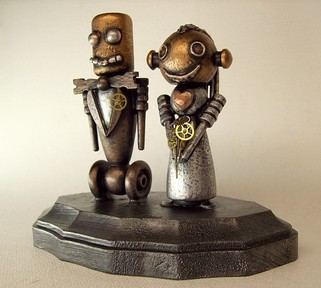
Dawkins himself writes in a footnote: “What on earth do you think you are, if not a robot, albeit a very complicated one?”
16 comments
Arnon
Do you actually enjoy writing? I don't mean 'being a writer', but writing itself: the actual sitting behind your computer, looking for words, trying to make them fit? Is that something enjoyable to you? Is it not frustrating?
If mankind were mere robots, the producing company should be sacked for grandiose negligence or incompetence, albeit some wonderful specimen are assembled.
Doormat
To quote the last two sentences of The Movo Tapes, by the infamous A.F.Th van der Heijden: 'Man, honestly, what is he really all about? A doormat of history, not worth even a footnote.' (Translation by me)
Arnon,
What is your title?
What about a book titled "See Footnote"?
Batta
Writing is a very decent activity compared to most other activities that are available for human beings of my age and gender.
Mr Grunberg
How do you choose your titles? Do you give them a lot of thought? Do they 'surface' during the writing of the novels more or less spontaneously or do you sit down to think about them? Do you think they should be some sort of abstract of the novel they represent (this seems to mostly be the case) , or could you also consider titles that are not so clearly conected with the content?
Are all your titles your own, or did your publisher have a say in them also? (I hear that happens a lot when an author isn't yet an esablised name - that the publishing company chooses the title)
Footnote
Isn't that how Coetzee treated his story - with extension life- in his novel 'Diary of a bad year'. The story is situated at the bottom of the pages while the essays are on top.
Arnon
It is a decent activity, but do you enjoy it? I guess I ask because I find writing a text a very frustrating process, although when it is done, I normally conclude it was worth it and I feel good. I wonder if you also suffer.
Mieke
Nabokov's "Pale Fire" is an example of an entire novel consisting of footnotes to a poem.
batta
Perhaps it's time to consider a different profession.
Hordijk
I gave my titles the attention they need i.e. special attention.A “foreign” publisher can ask the author if it is possible to change the title of a book. “The story of my baldness” is in Germany titled “Amour Fou.” “The Asylum Seeker” is in France titled “L’oiseau est malade”.“Tirza” in Italy is titled “Il maestro di cerimonie”.The “foreign” publisher cannot change the content of the book, but it is failry common that a title is slightly altered or completely changed. If my German publisher is telling me that a novel that has the word “baldness” in the title is not going to work in Germany, who am I to dispute this? The Spanish publisher of Marek van der Jagt asked permission to publish the books by Marek van der Jagt under the name of Arnon Grunberg. I granted this permission.Sometimes the title is there before I start writing; that was the case with “The Asylum Seeker” and “The Jewish Messiah”. Sometimes the title comes up with the first chapter (“Tirza”).Sometimes the title is there when the book is finished (“Blue Mondays”) or almost finished (“Phantom Pain”).Another time the title is there while I’m halfway the novel. This was the case with “Our Uncle”. The working title was “Shampoo”. Then I changed it to “Uncle” then “The Uncle” and finally “Our Uncle”.
Batta
I enjoy decency very much.
Oscar
Sometimes, one must simply suffer.
Phantom Pain
Thank you for that elaborate explanation, very interesting to hear some of that inside-information. I have to say, I have given the title Phantom Pain some thought in the past, wondering what the title is about. Is it because the main character, Robert G Mehlman is hurt by something that isn't there anymore? Bu what? His loss of decorum? Or is it to be understood in a more general way, like mankind as a whole is suffering from fantompain in this day and age, because we have all lost something, some essential connection with eachother, as you say in 'The technique of suffering', we live an 'age of betrayed trust' and we can only 'play real humanity and love ', 'humanity, warmth and love have become hypothetical.'
Do you think we all suffer from 'fantompain' ?
Hordijk
No I don't believe that we all suffer from Phantom Pain. (Although the lack of real suffering combined with a desire to suffer would qualify as phantom pain.) But I do believe that an author should not interpret his own books, therefor I politely decline to answer your question.