[ Previous ]   [ Next ]

Dog

Diamond studs

In the Times an interesting piece by a veteran: ‘Fast forward a couple of years. I am married. My paranoia is not as bad, but still there.
One night, I am taking my wife, Leslie, out to dinner for a “date.” As we walk to the table with the help of my guide dog, Brittani, we hear a voice: “Doggy, Mommy! There is a doggy!” “Yes, it’s a doggy,” the mother says. “You have to sit down and finish your dinner.” The child asks loudly why he can’t bring his dog to a restaurant. As I walk by the table I lean down and say: “This is Brittani. She is a working dog. She is my eyes.” I cannot see the look on the boy’s face. I know that people are sometimes taken aback by my appearance. My left eye socket is empty and my right one usually has a prosthetic with an emblem or logo. (I even have one with diamond studs.)’

You can read the piece here.

The last paragraphs are perhaps a bit too educational, but it is an insightful and important article.
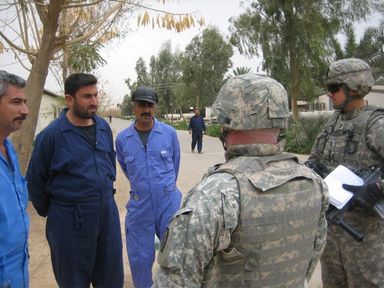
One can ask: where are the pieces about wounded Iraqi veterans or wounded Iraqi civilians?

How much even-handedness can you expect from a newspaper?

After all the Times is an American newspaper writing for an American audience that is mainly interested in American veterans, if it is interested in veterans at all.


12 comments Last_comment
I wrote a thesis on the topic of American newspapers and their coverage during the Iraq war in 2003. My conclusion was that the NY Times and Washington Post were not intentionally biased or pushing for a war, despite many blaming the media for jumping on Bush's bandwagon. The problem was more an unintentional bias, where 'big actors' like a Colin Powell get more attention in a daily newsflow than a smaller, more critical voice. More personal stories less frequently make the front page. Also, hopeless story is not always what people want to read about in the newspaper, wether we think that's right or not.
Veteran
The guy does have a rather peculiar sense of fashion...
Free press...
...is an illusion.
G T
How do you distinguish in this context between an intentional bias and an unintentional bias? Are you referring to the buildup of the war in Iraq? That war definitely started in 2003 but when it ended, and if it has ended, is open for discussion.
In my opinion these papers were not intentionally biased because they often published articles that were very critical , its just that they gave the front page to the Bush administration that was making bigger headlines., hence the bias is only in strucural form but neverthless influential to the readers. The thesis was published you can read it online if you like. Sadly, in the case above it shows people are more interested in reading about the dog than the veteran.
Very relevant questions indeed
G T
I would love to read your thesis.
Have you read Chomsky's "Manufacturing Consent?"
Your analysis of intentional and unintentional bias is not very convincing I have to say.
It's not only the content of an article that matters, the actual place of this article in a newspaper matters a great deal. It's quite a difference whether an article is printed on the front-page or on page 18, to give an obvious example.
Where (and when!) an article is printed is a conscious choice, made by editors. When this choice results in bias the bias is intended.
Actually the intention of bias is not as important as its outcome on the readers and I conclude that the media acted as a mouthpiece for the government by not actively placing critical articles on a more prominent place . The thesis is called 'Watchdog on a Leash', and no I haven't read Manufacturing Consent., why do you recommend it in this context?

http://igitur-archive.library.uu.nl/student-theses/2006-0324-081538/UUindex.html
G T
"Manufacturing Consent " is an important book about intended and sometimes less intended propaganda in the mass media. I.e. very relevant to this discussion.
Sounds very interesting, I will be sure to read it.
Today I was quite sad, but the thought of a diamond eye made my day.
Helping the blind
Good metaphor, for me, in the article is: helping the blind in a direction you think (s)he favours, and do this with the best intentions. And no questions asked because the way this rare creature moves implies a bad mental condition.
This also goes for wars fought and for information shared.