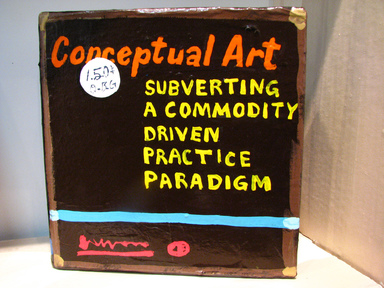
2009/11/21 Dusseldorf
The university of the obvious
Lugubrious
"In 1969, we were very free." That’s the first sentence of Peter Schjeldahl’s highly readable review of “1969”, an exhibition at P.S. 1.
The last paragraph of Schjeldahls’ review:
‘“1969” is authentically lugubrious; the only truly depressing aspect of the show is the inclusion of new work by young artists who prove that conceptually driven art, as a phenomenon in and about institutions, has gone essentially nowhere in forty years. Stephanie Syjuco re-creates works by Beuys. Why? (Richard Pettibone’s miniature repainting of a Frank Stella was already jejune in 1969.) Hank Willis Thomas reasonably—but tediously—fills in a missing African-American perspective with pieces reproducing pictures and headlines from Ebony and Jet. Messy installations by a group called the Bruce High Quality Foundation coyly critique museum functions. It seems that we’ll never be permitted to graduate from the university of the obvious.’
I have to admit that the distinction between conceptual art and long-term unemployment is not always clear to me.
A benevolent take on conceptual art would go like this: most art is made for humans, some art is made for pets but conceptual art is made for God.
13 comments
Long term unemployment
I think it's easier to turn conceptual art into a long term unemployment than the other way around.
Die Auseinandersetzung mit dem Dasein
"Art", like "beauty" is hard to define. I would claim that true art is a physical expression of the struggle of the artist with reality. In other words, the struggle of the artist with his or her own existence. The fact of existence we share with the artist. This is possibly why art has the property of telling us something about our own existence.
I don't often see much struggle in conceptual art.
carlos
I appreciate your definition but according to your definition one could state that baseball, soccer, and basketball (to name just a few sports) qualify as "true art" as well.
Arnon
Perhaps "communication" or "manifestation" is better than "physical expression". It is an interesting question: where does art end? Could Mishima's suicide be regarded as his last work? But then why not Hemingway's?
Of course I am biased. I would tend to see art as an act of rebellion against the banal materialism of society.
Carlos
Do you believe that art remains outside the capitalist economy?
Arnon
The question is whether the artist is the exploiter or the exploited.
Carlos
Can you give an example of an artist who happens to be an exploiter?
Arnon
Of course not. This is my point. One could argue that even death does not protect an artist from exploitation.
I suppose an artist is capable of manipulating his or her audience. But I doubt that this amounts to (capitalist) exploitation.
@Carlos Dee
Dear Carlos,
It is indeed like this: footballplayers, manicurists (thinking of Irina) and writers struggle with existence. So do visiual artists. You, like many others, impute a Jesussyndrome to the artist: artists, in their way of expressing emotions and difficult questions about our life and the universe, have to carry their cross. Some people struggle more than others and people who like to ask questions may not always get the answers and yes, those people have to consult philosophie, doubt, drugs and sometimes pens and pencils.
But in general, artists do not have to suffer like that to create. And for sure suffering doesn't count in judging, critisizing. The capitalistic vaulue of a work counts, expertise/craftsmanship may count, raising questions, being signed by Damien Hirst counts, quality does count.
If you like rebellion have a look at Banksy, who of course wouldn't work like he does without current ecnomic structure.
Sol Lewitt (conceptual artist) explained in his 'Sentences' what the concept art had to say to the world of art.
Arnon
Damien Hirst, for one, is a master in exploiting the capital system and raising a lot of money for his work. He was the first to leave the system of galleries and sell directly to the market with the use of Sotheby. But even in this scenario his work still stands.
Hanny
I don't see the artist as some kind of saviour. A struggle is not the same as suffering. Don't you think any form of art is a confrontation with reality? Does the "capitalist value" of an object somehow make it more artistic? Were Van Gogh's paintings somehow less meaningful when they were regarded as having no financial value?
Is an Ikea store really a disguised museum of conceptual art?
Mieke
Damien Hirst's "works" stand. That's about all that can be said for them.
The word "con-artist" comes to mind.
conceptual
All right, let's call all conceptual art a load of crap, and conceptual artists the 'ultimate bullshit artists' or 'con men'.
Take a noun, check its meanings and associations/connotations in some dictionary/encyclopedia, visualize some of the more 'concrete/substantial/material' nouns and dump 40 bricks on some museum floor somewhere.
That's it, really.
========================