[ Previous ]   [ Next ]

Power

Misconception

“When I first began writing for The Times, I was naïve about many things. But my biggest misconception was this: I actually believed that influential people could be moved by evidence, that they would change their views if events completely refuted their beliefs,” Paul Krugman wites in today’s Times.

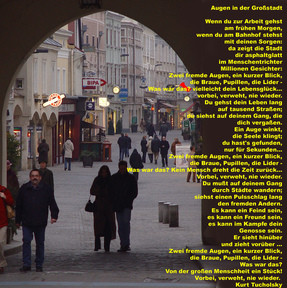
Not long before his suicide in 1935 the German satirist and columnist Kurt Tucholsky lamented that although he used to be one of Germany’s most popular columnists he had not succeeded in forcing even one policeman to resign.
(Unfortunately I could not find the exact source, so all I can offer for now is a paraphrase.)

So much for the power of words.


25 comments Last_comment
Cretinism
Krugman is surely aware of the phenonemon of "parliamentary cretinism", which according to Marx "holds those infected by it fast in an imaginary world and robs them of all sense, all memory, all understanding of the rude external world."

Democracies have a tendency to be ruled by cretins and mandarins - a bad combination.
grossartiges gedicht!
geniale reime!
and i love these dots...
kurt tucholsky wir ehren dich!
or the power of art. I remember a poem of Tucholsky "Revolution! The people howls and cries, Freedom, that's what we're needing! We've needed it for centuries, our arteries are bleeding. The stage is shaking, the audience rock. The whole thing is over by nine o'clock.”
Arnon
There is hope though, because Krugman continues with the quote:
"And to be fair, it does happen now and then. I’ve been highly critical of Alan Greenspan over the years (since long before it was fashionable), but give the former Fed chairman credit: he has admitted that he was wrong about the ability of financial markets to police themselves."

But he’s a rare case.

Is Krugman cynical?

Because Greenspan was one of the most powerful people in the financial world, and Krugman was still a columnist then (and a brilliant economist) well, i think he was not.

So cheer up Arnon, even the queen says or will say to her oldest son: "Is that so? Well i spoke to Arnon and he said.." or even better: "You should call Arnon"
Careca
After Greenspan resigned as FED chairman he admitted some mistakes. AFTER.
When people resign from powerful positions or when they are forced to resign they sometimes change. Think of Jimmy Carter or Mr. van Agt in the Netherlands.
And don’t get me wrong: I’m not lamenting the limited power of the written word.
And you don’t think Krugman was a brilliant economist? Or you don’t think Greenspan was one of the most powerful men in the financial world?
Nevertheless I like to read those words. (And we all want – at least - to influence people by any means, ‘although if violence is not necessary, then presumably, it should not be used’-Sartre)
didn't Tucholsky say 'politicians' instead of 'policemen' ?
Limited, yeah
I am glad words only have a moderate power over people. Imagine a world where all ideas, including the bad, are forced upon people with powerful words...

I think those who overestimate the power of words underestimate the critical thinking of the common people.
Arnon
Maybe you can join this couple on holiday

http://www.youtube.com/watch?v=QLoQJVajLXI
Sander
Perhaps you underestimate the power of words and overestimate the critical thinking of the common people.
Allemagne
To the best of my recollection Tucholsky was referring to a policeman (Polizist).
Sander / Carlos
It all depends on what kind of judgments. It does make a difference whether we are speaking about the question where to buy the cheapest toilet tissue or how to fight a recession, to name just two examples.
When it comes to buying toilet tissue I tend to trust both the judgments of ordinary people and the specialist’s opinion.
Arnon
When it comes to buying toilet paper I trust my asshole. (To put it rather bluntly.)

I do get your point. Although I'm not sure intimate products such as toilet paper are a good example. It's not as if toilet paper brands are a common subject of discussion on TV talk shows or at family birthday parties. (Although I'm sure there are a few exceptions.)

I do wish the powers that be would listen to Krugman though.
Carlos
That should be the slogan for 2010:

Dare to trust your asshole.
Words
It is a strange idea that words would not be powerful. What do you think drove the actions of Greenspan if not words - in his case, the words of economic orthodoxy? Little elfs? Payments into his bank account? The frequency with which his wife allows him access to her nether regions?

By the way, Krugman talks about evidence, which is a much more narrow category than words. The problem with evidence that there is too much of it. In the recent documentary American Casino, Greenspan is interviewed about his role in the crisis. One of his defences for his lapse of judgement is that there is and has been a considerable amount of evidence to support economic orthodoxy. It is difficult to give that up as soon as some seemingly contradicting evidence comes in.

So Krugman is being a bit self-serving by framing this issue as evidence versus beliefs. They always co-exist and evidence typically has to crowd out other evidence. Of course, this can be painstakingly slow and thwarted by people who have vested interests supported by the existing evidence.
Michel
You could argue that most if not all actions are driven by words. If that’s enough evidence for the theory that words are powerful is doubtful
What mattered was Greenspan’s position i.e. the power to take action.
That is what Krugman was saying – whether this is self-serving or not is a different question.
Arnon
I'm afraid I don't understand your comment. I re-read Krugman's piece but I don't get your point. Yes, Greenspan had the power to take action. In fact, he did take action: he further liberalized the financial markets. He ignored words and evidence in the process, unfortunately, but he was supported by the words and evidence of mainstream economics. What does that tell you about the power of words or evidence?

The fact that a columnist -- Tucholsky, Krugman, whomever -- is frustrated for not being able to get a politician to resign is not really proof of anything, except the power of columnists. Perhaps there is good news. Castells recently published a book which highlights the increasing importance of scandals in today's politics. If there is one thing columnists should be able to achieve, it's scandal.
Arnon
If you'll allow me, I'd like to ask an off-topic question; Can you suggest any books that deal with fatalism? Fiction or non-fiction. Thanks.
Michel
Perhaps we should distinguish between ideas and words. Ideas consist often of words but not all words are necessarily ideas.

Your argument goes like this:
Adolf Hitler wrote Mein Kampf.
He took action. (In many ways he did what he promised to do.)
Words are powerful.
Kurt Tucholsky tried to change the course of (German) history. His words were not powerful, because he was a columnist.

Furthermore, you don’t take Tucholsky’s position seriously, which is an underestimation of both Tucholsky and recent history.

I don’t see the need for (more) columnists causing scandals.
We have already talk shows, talk radio, and tabloids – do we really need more scandals?

As to fatalism -why not read “Oblomov” or “The Garden of the Finzi-Contini’s”.
Arnon
You have a point, my argument is quite inconsistent. Let's throw it out.

What is your argument exactly?
Krugman tried to change the U.S. regulation of financial markets.
He failed.
Ideas are powerless.
Greenspan supported the ideas of mainstream economics.
He took action, liberalized the financial markets.
He succeeded because he had power.

Correct me if I'm wrong.

I don't know where you think you read I don't take Tucholsky seriously. I only mention him once, next to a Nobel laureate.

As regards more scandals: I was being ironic. Given the quality of most columnists, less power to their ideas is better, as far as I'm concerned.

Thank you for the suggestions re: fatalism. I appreciate it.
Word power
Perhaps we need to avoid the term "power of words" and rather use "power of the idea" and "power of the evidence" (two separate but related concepts).

Unfortunately, society also has what we might call a "power of the status quo".
Carlos
Do you think that the status quo can exist without ideas or evidence? If so, where can I witness such a status quo? You seem to imply that only the people outside the status quo have a brain.
Michel
All I was trying to say was that if Krugman had studied history a bit better -- as economists ought to do - he would not have been surprised about his lack of influence.
P.S.
On the power of ideas, more specifically Krugman's ideas: this week's New Yorker quotes a Chicago economist, who states that "if you are getting attacked by Krugman, you must be doing something right."
Michel
Thanks! I will read the article.