2010/09/01 New York
Too human
Cameraman
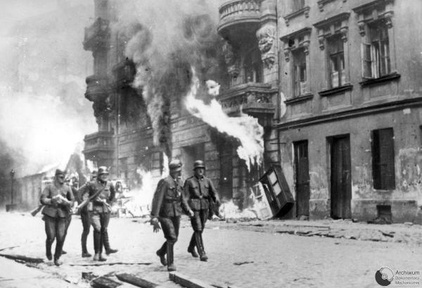
Last night I saw the documentary “A Film Unfinished” by Yael Hersonski. It’s a documentary about an unfinished propaganda movie by the Nazis about the ghetto of Warsaw.
One of the witnesses is cameraman Willy Wist, who shot the original movie for the Nazis. His testimony is all too human, but filled with small contradictions.
“A Film Unfinished" is recommended. But it is strange that nowhere in the film, not even in a single sentence, the uprising of the ghetto of Warsaw is mentioned.
10 comments
choices
in the movie language it isn't possible to mantion something of such a importance in one single sentence, a filmmaker would have to support it with a story and of course the visual background (it's a film after all). I'm sure someone has mantioned it while shooting but one makes choices at the editing Thanks for the reccomandation.
today is a very sad day in Warsaw.
http://www.youtube.com/watch?v=xWI16RfhQkE&feature=related
too human?
You mean "menschlich al zu menschlich"?
Also Propaganda?
Iz
Please, please do not forget that Warsaw knew two different uprisings during World War II. The one Anna Maria Jopek so beautitfully sings about in the clip, is the one that broke out not on the first day of september as you suggest, but on august the first of 1944. The uprising in the getto took place one and a half year earlier and started on 19th of April, the eve of Pesach. This uprising was neither less tragic nor less brave and even more doomed to be cruelly crushed by the Nazi's than the one you are referring to. The few Jews who survived this uprising later fought in the (second) Warsaw Uprising. Please don't forget....
Karol
Thanks Karol.
A year ago Timothy Snyder wrote in The New York Review of Books:
“Poland’s history is the source of endless confusion. Poland was attacked and occupied not by one but by both totalitarian states between 1939 and 1941, as Nazi Germany and the Soviet Union, then allies, exploited its territories and exterminated much of its intelligentsia at that time. Poland’s capital was the site of not one but two of the major uprisings against German power during World War II: the ghetto uprising of Warsaw Jews in 1943, after which the ghetto was leveled; and the Warsaw Uprising of the Polish Home Army in 1944, after which the rest of the city was destroyed. These two central examples of resistance and mass killing were confused in the German mass media in August 1994, 1999, and 2004, on all the recent five-year anniversaries of the Warsaw Uprising of 1944, and will be again in August 2009.”
See:
http://www.nybooks.com/articles/archives/2009/jul/16/holocaust-the-ignored-reality/?page=2See also:
http://www.arnongrunberg.com/blog/1095Evidently not only German media are confused, some of the readers of this site live in confusion as well.
Karol
before i choose the song of Anna Maria i was thinking about choosing a jewish tango with the pictures from the uprising AD 1943, but i thought Anna Maria's song (written for the anniversary of the uprising indeed AD 1944) echos the surrow of the destroyed city and it's citizens, all of them. Famale point of view i guess.
P.S. Have you read 'Lalka' by Boleslaw Prus lately?
Iz
Are you Izabela Lecka? No, not lately and yes, my first and last wish during my life as a translator of Polish literature is to translate this magnificent novel into Dutch.
Warsaw
First heard about Warsaw and the war when I was a 5 year old kid. My aunt often played the ‘Warsaw Concerto’ on her Grundig radio/record player.
(see
http://www.youtube.com/watch?v=L8q0JD0_VEg&feature=related)
She told me this concerto was played for the first time when the Germans were bombing the city… That night I had horrible dreams about a city in flames.
Karol
great aspiration you have there! go for it i shell say, you are quite ready for it, with a bit of luck and imagination you might get the finances. The way he writes about Warsaw! even sharper then Couperus about the Hague.
By all means, no! i only share the name of this woman. I was referring to 'Lalka' cause i'm deligthed to read it now (again, now, when i'm bit more mature and able to be deligthed with this masterpiece) in the III chapter, Mr. Ignacy Rzecki writes in his diary about his youth, when he was a clark at the store owned by an old Jew Jan Mincel, from whom he learned all the secrtes of the profession, everything a good merchant ought to know. Great piece, this diary of Rzecki: 'Okolo osmej naplyw interesantow zmniejszal sie. wtedy w glebi sklepu ukazywala sie gruba sluzaca z koszem bulek i kubkami(...) a za nia - matka naszego pryncypala, chuda staruszka w zoltej sukni, w ogromnym czepcu na glowie, z dzbankiem kawy w rekach. Ustawiwszy na stole swoje naczynie, staruszka odzywala sie schrypnietym glosem:
-Gut Morgen, meine Kinder! der Kaffee ist schon fertig...
I zaczynala rozlewac kawe w biale fajansowe kubki.
Wowczas zblizal sie do niej stary Mincel i calowal ja w reke mowiac:
-Gut Morgen, meine Mutter!'
i can easily imagine this Warsaw.
why don't you read it again?
Bernard
my grabdpa has got (yes, he still has it) such a áncient Grundig.
and... music carries the compassion