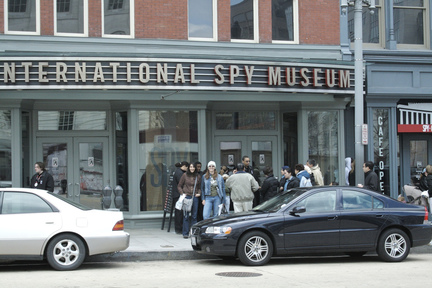
2007/07/19 New York
A stomach ailment
Mr. Marwan's story
This is a story published a few days ago in the Times but worth reading:
“Mr. Marwan’s story — a tale overflowing with the suspense and ruthless duplicity of a spy novel — began to take shape in the spring of 1969. He had come to London, ostensibly to consult a Harley Street doctor about a stomach ailment. He chose to be examined by a doctor whose offices had been used previously for a covert meeting between King Hussein of Jordan and the general director of the Israeli prime minister’s office.
Along with his X-rays, Mr. Marwan handed the doctor a file crammed with official Egyptian state documents. He wanted them delivered to the Israeli Embassy in London.”
Mr. Marwan who died a few weeks ago in London – the circumstances of his death are not completely clear yet – might have been just a spy, or maybe a double agent, or who knows a triple agent.
I assume a double agent. But who knows.
22 comments
Interesting story.
I assume that those two girls smiling to the camera aren't spies.
What about YOUR health? Are you doing a bit better? I truely hope so.
Do you have anything to say to my idea of having this picknick? I am a writer, no boxer. And i am not ironic at the moment.
Friede
Please contact Johannes for the picnic – he is head division picnics and sustainable development.
Picnic
That's right.
Everyone who is into the picnic, please send me an e-mail.
johannes@arnongrunberg.com But please, no more hatemail. Enough is enough.
I'll bake a cake, I promise.
Johannes
Could you please tell me if any of the regular commentators is sending you hate mail?
Dens
Your assumptions are as often fairly balanced and fairly modest as well.
Friede
Are you a published or an unpublished author? If you are published who is publishing you?
Arnon,
I was joking. No one here would ever do that of course.
However, as the bastard of this site I need some hatemail though.
Fairly balanced
But I'm mostly in doubt.
Arnon
I have to become old and energetic first.
At the moment i am an unpublished writer who's mainbusiness is visual arts.
The double agent is an interesting figure. Is there a characteristic psychology of the double agent or are they all different? As regards the few cases that I know, they all seem to have been tormented souls; alcoholics, a twisted sexuality or a history of child abuse. Robert Philip Hanssen, the latest in the row and living in solitary confinement now, is said to be motivated by a need for recognition and friendship. His biggest fear was that one of his Russian handlers was a double agent like him. A slightly paranoic universe. If there exists a psychology of the double agent, the fear of disclore and the fantasy of being the most beloved child probably plays a role, but loved for a special reason, loved for your knowledge, and in the life of a double agent, that is always treason. Anyway, double or triple agents seems to me a bit nostalgic figures. Nowadays we have Austin Powers.
I can agree with Johan Schokker on the psychology of a double spy, the feelings are familiar to me. Good insight.
Please Johannes, do not play drama with hate mail. You should know, by appointment of Arnon, I am the only Drama Queen here, and a lovely one too! Like the queen of hearts in Alice in Wonderland, I am also extremely jealous. But you can be head division bastards, I always need some of them.
Kind regards.
Jan Thys
Are you a double spy?
Dens
You mean on the modest level of family and office affairs? Of course I can give no comment on this, you naughty boy.
Johan S
If you go back to the post Elite Plus you will see that I answered your last comment and asked you a question. Maybe you chose to ignore the question, but in case you didn't here is a small reminder.
I'm not sure if Austin Powers is a competitor to double agents.
Spy
The closest I ever came to a spy was an one of my trips from Israël to Brussels. If I recall well , there where something like nine people on my tail at a certain moment.
There was the tourist with the hawaiian shirt, the man with the telescopic camera aimed at me, the girl behind the coffeebar, three people in the plane, a couple and a woman, and to conclude two man in a car in Brussels who all followed and watched me carefully. I must say I felt honored by there attention.
If you ask me why they where following me, all I can say is that I felt bored and I teased them to get there attention and they gave me the full package.
Afterwards I didn't feel bored for a lang time, but still whenever I come to close , they 're back on my tail again.
Arnon
To answer you:
-The work of Sade cannot be read on a psychological level. His work is ‘artificial’ and perhaps the best way to characterize it is as ‘experimental literature’ and, as a lot of experimental literature, Sade has the typical effect that he bores the reader. But, in spite of being boring, Sade can be read, that is, read as a fantasy. In that way reading Sade is instructive. To give an example; the hardly believeable survival of the victims in Sade’s fiction who are subjected to the worst imaginable torment. That can be read as a sign of the perverse universe in which death has no place. It is ‘Tom and Jerry’.
-It is obvious that you have read Lacan. It was after all Lacan who stated: ‘Truth is structured as a fiction’. I find it praiseworthy really, when you write, and I paraphrase of course; “I, as an author, am in search for the truth, and if it is necessary that in order to find the truth I have to go to fallow grounds, I will go there.”
-Writing that ‘apples are healthy’ is a bit as nails in a table; it makes the work more robust. Perhaps I am mistaken.
At this moment psychoanalysis is in coma, and if you look the patient in the eyes you can see that an awakening is not very likely, but the great psychoanalytic themes are still very much alive in modern literature, and that could very well be a sign on which one can place hope. I mean, a book as ‘De asielzoeker’, is it possible not to read it as a modern variant of the Oedipal structure? It is so clear that it is almost impossible no to see it. Lacan is not different from Freud, it is almost the same. Lacan stresses more as Freud the materiality of language, that is, in his vocabulary, the signifier. To take as an example the aforementioned novel, in a lacanian reading I could say: Beck, the name of the main character is pronounced as ‘back’, which is exactly the place of the malignant tumor that makes his wife sick, and as such ‘the symptom’ that he represents for her, that is, that he made her sick (a sign of true love?). But as I wrote before, the value of such a way of reading is limited.
-As concerning my brother, his name is Tim and he is my twin-brother. I made the mistake to write a book on Lacan with him, but it was a ‘worse-seller’ if ever there was one and thus it is unfindable. I do not regret it. We can write something else.
Jan Thys,
I'm very glad you hate me for it.
Arnon
Re-reading this morning what I wrote I see that calling ‘apples are healthy’ a nail is not a very clear metaphor, to say the least. It is a difficult subject. ‘apples are healthy’ is a truth, but it is not the truth that you are searching and perhaps, in the end, you are. To be honest, I had the analytic session in mind. Let me try to catalog. To say, in a situation of analysis, ‘apples are healthy’ can be, first, a provocation. That happens, but is not really important. Second, it can be a citation. As a child my father said to me that apples are healthy and this had a particular meaning for me and I can reflect on it and associate etc. Third, it can be, what I call here, by lack of a better word, ‘a nail’; at a certain moment of your associations you can lose track and to put yourself on your feet again, as it were, you can say: ‘apples are healthy’. It is a relieve that a least you’re sure that apples are healthy, that no matter what happens to you, you can take with a good conscious an apple. Such statements can then have the function of stepping stones. Fourth, it can be a conclusion. This is of course the most interesting case and I am not sure if it is really valid. Is it possible to express the truth about yourself in a sincere way in a commonplace as ‘apples are healthy’? I am inclined to confirm it, but on the other hand... After all it is not a bad definition of perversion, the idea that every singularity can be expressed in a universal as ‘apples are healthy’. It could be argued that therapy often works like that, the therapist has at his disposal some general statements like ‘apples are healthy’ and ‘the sky is blue’ (it is what is called in clinical psychology the DSM), and his task is mainly to bring his patients to a conclusion. ‘Apples are?’ ‘Healthy?’ ‘Indeed. Was it that difficult to say?’
But saying ‘I am a woman’ can be a deep felt truth. I am not sure if it can be the last.
Excuse me if I am bothering you with the obvious. I have a habit of doing that.
As to Austin Powers – since I am not particular fond of his humor. I am well aware that in the world of today double agents still play a role and it is not so much a question of replacement, but an answer. James Bond is the gentleman-spy that represents a world in which the boundaries were still clear, while Austin Powers as a parody seems to me to represent a reaction on the loss of James Bond, - I mean of course the world that he represents – with the implicite message: it may well be that the world is complex, it may well be that people are starving in Dafur, innocent are in detention in Gitmo etc. etc., but at least we have fun, at least we enjoy. In lacanian terms, it is the command of the super-ego: ‘Enjoy!’, the implicite parental message which is so typical for our times: ‘no matter what you become, but be happy, enjoy life.’ The injunction of enjoyment is of course a perfect way to make enjoyment impossible. ‘You have everything, and still you’re not happy’. The sadian universe is the ultimate consequence of a world in which only the commmandment to enjoy reigns. Sade is a man who in the end states:’I accept only one law, to enjoy without any limite’.
Perhaps too long this comment, but I hope it clarified things a little.
Johan Schokker
You were thinking of the context of analysis I was thinking of the context of the novel. The statement “apples are healthy” – whether we agree with this statement or not – seemed to be a statement that is valid outside the fictitious world of the novel. By invoking such a general statement in your fictitious text the fictitious text becomes more real. Karel van het Reve, a Dutch essayist, has written about this technique with more insight that I managed to do here.
An analyst who declares in real therapy that apples are healthy is of course doing something else.
I haven’t read Lacan by the way, my former publisher in the US who happens to be also a therapist, Judith Gurewich, urged me not to read Lacan, because he was unreadable according to her. For once I followed her advice.
On a different note: you are suggesting but correct me if I’m wrong that because people are starving etcetera we are less entitled to enjoyment. On a pure ethical level this is probably right, but on a more practical level I would like to object.
Sade informed us that the suffering of others can be our entertainment, our joy, I think he can be read on a psychological level, and a little bit of self-knowing should reveal that our breakfast is going to taste even better when we think of other people starving.
I’m not saying that we are sadists, that would be a non-sequitur and besides that in general seeing other people suffer is upsetting, however this feeling of being upset can be entertainment as well, but most of all there is a need to know that we have something that others don’t, that we have won the fight. We can discuss whether this need is in our genes or in our culture or both, but to act as an analyst (and a novelist by the way) as if this need doesn’t exist seems to me short-sighted – here also I disagree with Elie Wiesel, I think that people are entitled to indifference, it’s not nice, it’s not great, it’s often not ethical, but they are entitled to it, they are entitled not to be disturbed in their own enjoyment.
Arnon
Thanks a lot for your respons which I liked a lot. A bit too serious maybe. But well, after all, there is nothing wrong with being serious, now and then. And probably you thought the same: okee I can, more or less, agree with what he writes, but a bit too serious... At least I felt so.
I do not want to convince you to read Lacan, and seriously I have never dreamt that you would have. I meant to say: you have been reading Lacan, while actually you have never read Lacan. Surely. A deplorable attempt of irony.
Can you be a lacanian without ever have read a single letter of Lacan? It cannot be completely excluded.
Concerning your second point, that people are less entitled to the their enjoyment because people are starving. Who do you think I am? A priest? I am writing in the tradition of psychoanalysis and psychoanalytic theory. I take the blame, I am writing not very clearly. But Freud would say: love is a precious thing, we, as human beings, do not have a lot to share, to love the people starving in Dafur... All of them? As Dostojevski would say, I believe in ‘Notes from the underground’: ‘Let me drink my tea!’
But as I said, I do not blame you for this misunderstanding, to speak about the super-ego would take a few more words. Super-ego is what makes of our anxiety a feeling of guilt. My pont is just the other way around: we have to enjoy, because people are starving in Dafur. But you’re right, I should not have come up with the people of Dafur, it is not relevant, the super-ego is much stronger: enjoy, enjoy in all your stupidity, enjoy, that’s all.
The super-ego is a commandment to enjoyment. And that can be in itself an enjoyment, as Freud knew very well. And as Lacan said, on the level of the drive the subject is always happy. The subject is happy because he/she enjoys. Point. One way or the other, the subject enjoys.
As to Sade and the point you make; of course you’re right, but it is simply not the final word, in the end it is not enough to know that you have won the fight: things are a little more complicated. I grant you the victory, I bow my head. And then, what happens? What are you thinking about taking your diner? About me? I do not think so.
It is a bit the point of Sartre that you make, who I am reading at the moment. Truely a great writer. If you read Sartre you must admit that he was a great psychologist, but Lacan is closer to the truth.
To conclude, Judith Gurewich, I know her name, and I know what she has published on Lacan in the US. I am not going to be negative about the brave attempts she made, to introduce a little Lacan in the States. I may not agree with everything, but still: a great attempt.
To end or to continue: do you have any questions? I would like it if you have. To be honest, I have not much to offer. I like psychoanalysis. That’s all. I also like literature, but I like psychoanalysis more. Have you recently seen a movie that you liked and intrigued you? If you want I can give you a lacanian interpretation, it does not matter which one. Could also be a novel, but that is more work for me. Or do you prefer the subject of perversion? Well, only if you want to, of course. The best anyway.
Johan
There is a comparison between a priest and a therapist don’t you think?
I missed your ironic attempt – I took your question at face value.
The moral obligation to enjoy might summarize everything that lurks between words as freedom, democracy and human rights.
But maybe I’m busy misunderstanding you, so I need to know what exactly do you mean with the word enjoyment.
Give me a lacanian interpretation of the movie Scarface.
And also try to analyze what it means when you inform me that you don’t have much to offer.