2007/09/21 New York
Ordinary
Crimes
In the unsurpassed movie theater Quad Cinemas I saw last night the documentary “The Unknown Soldier” by the German director Michael Verhoeven.
The immediate cause for this movie was the exhibition “Crimes of the German Wehrmacht”, which caused considerable discussion in Germany a couple of years ago.
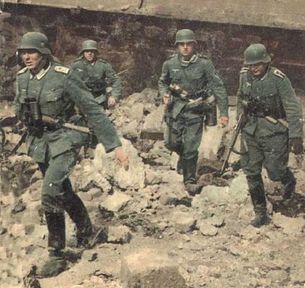
For a long time the myth existed that the Wehrmacht (in other words the ordinary German soldier) was not involved in any of the crimes of the Nazi-regime.
The exhibition proved that the Wehrmacht was very much involved in the killings of civilians, mainly Jews, and prisoners of war.
Every army exists because its soldiers and officers are willing to obey orders.
Nevertheless there were German officers (a small minority) who refused to kill civilians, although they got the order to do so. They were not punished for their refusal.
As was pointed out to me during my visit there (February 2007) certain doctors and psychiatrists in the US army refused to work in Guantánamo Bay. They were not punished for this refusal.
Not only this documentary but also other movies by Michael Verhoeven are worth seeing.
10 comments
Crimes of the Wehrmacht
My dad was sent off to Latvia by the Wehrmacht as a result of stealing from freighttrains in Amsterdam in 1943. The camps were called 'Arbeitserziehungslager' and were manned or guarded by both Gestapo and Army, because in those parts of the Third Reich, the Russian threat was imminent
His experience with the Army is such that he had a lot more problems with the ordinary, low in rank, average soldier, than the average Gestapo-soldier or
-officer.
Maybe it had to do with the 'will for survival' attitude among the Dutch prisoners who were forced into hard labor in the mosquito infested woods and lakes around Riga.
The International Organisation (branch of the UN) that defends the rights of victims of forced labor during WW II, should have a fair account of those crimes.
The sad part is that -internationally, and thus by Germany- these people, from various countries, were never recognised or acknowledged as real victims of WWII, because being forced into hard labor -universally and/or globally- has never been acknowledged as a crime against people. No help has thus been granted by the German govenment for the pople who often became lifelong victims....
These people , who are in their eighties now, rest with the feeling of being misunderstood and abandoned by a large part of the world, especially Europe.
They do not have a voice.....
The second worldwar -of course- has had many of those seemingly small and relatively unimportant human dramas.
I
Ybe
It’s true that many victims of Nazi Germany for a myriad reasons have been overlooked, and when it comes to financial compensation, whatever we think of that, certain types of victims (I apologize for putting it like this) have been overlooked as well.
Oscar W
Thanks you for the link. The Dutch newspaper NRC Handelsblad had a story about these pictures today on the front page.
Ybe,
This may be impossible to answer, but how has this history of your father determined/influenced your own life: ideas, choices etc.?
And yet in those days leaders took there responsibility (even Hitler declared: the responsibility in mine only). Nowadays we observe a shift to force responsibility to the lower ranks only, the executioners on the field, so the leaders keep clean hands.
Not only an army exists because people want to obey orders, an army also exist because a lot of people adore to give orders and love to accumulate power and wealth in huge amounts..
Jan T
Yes, but the ones giving orders need helping hands.
@Arnon
Today I bought my third Coetzee, Youth. I really start to like this guy a lot, he is funny in a particular way. You introduced me to him, now I almost feel like a betray you. Ah, my perfidious heart.
Ordinary
First I thank Arnon for his kind words.
As to Johannes van der Sluis' question. Johannes, never before have I been askes this question. I find it hard to put in words., like you already predicted.
What I did learn from this whole business, is the fact that although my dad was for a big part, really 'out of harms way', in the end (and I think it is fair to say that at the age of 86, one is soaring towards the end) everything that happened in those days, has affected him more than he is willing to admit and it starts showing.
He talks of the camp because it has returnedf in his dreams, still dreams, not (yet) nightmares, so what can we learn from this, besides the fact that it is probabl not a good thing to keep it hidden all those years (my dad rarely talked about this period in his life)
This is as far as I get Johannes.
Jan Thys
If you betray me with Coetzee I can only feel honored.