2007/09/26 New York
Serious readers
No longer life
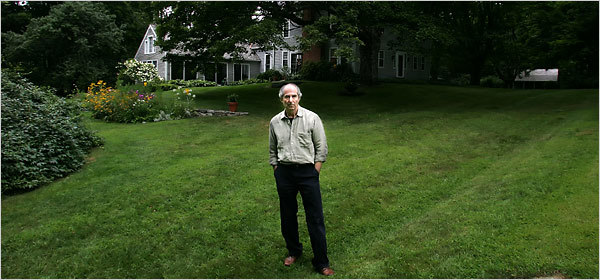
In this week’s New Yorker Hermione Lee talks with Philip Roth about his new novel “Exit Ghost” – the interview is slightly hermetic. Mr. Roth says: “The book is full of allusions to writers because all the major characters in the book are either writers, aspiring writers, translators, or serious readers, and such people talk a lot about books – at least that’s my experience with the writers I know.”
And also: “To begin with, Zuckerman is a novelist, and it is the way of the novelist to take the raw material of life and transform it into something that is no longer life but language, language in the service of a surmise.”
The Dutch essayist Karel van het Reve once criticized Mr. Bellow’s novels by saying that the characters in these novels talked as if they were reading the New York Review of Books all day long.
Nothing wrong with reading the New York Review of Books all day long, but the question remains if the novelist transforms raw life into something that is no longer life.
Means transforming raw material into language killing the material?
29 comments
It depends on in which language the writer transforms his raw material, I suppose.
Maarten
You must be kidding.
It can either kill or conceive.
Btw: I remember somebody on this site claiming that the writer only lives when he is writing.
Only if the writer is a bad writer.
Transformer
When contemplating or remembering an event we already transform the raw material into a kind of a story for yourselves. When we try to put words on paper, we have a third person, the reader, in mind and are transforming the story even more to make it acceptable and stylish. I think a good writer can transform the raw material into a well balanced, delicate and rich story that does honour it’s origins and appeals to the reader.
kidding
I'm not. Not every writer has the gift of breathing live into his language. And I think the others here agree, more or less. Only opinions differ on the point which writers do have this gift. Some view Saul Bellow as a very talented writer.
Kidding...
Thinking of Jack Kerouac, reading his books I don't think any life is killed in his writing. On the other hand there are writers who are so bad you wanne kill yourself (or them), they kill even more then only what they write about...
so I agree with Maarten Dessing, it depends on the writer
@Maarten
For a while I thought by ‘which language’ you mean ‘Spanish, Dutch or English…’ I was mistaken.
I don't think it kills the material. It's more like putting music on paper. It might look a bit dead, but if the reader knows how to interpret musicscripture then it will certainly come to life again. Even a deaf person can hear the notes if he knows how to read them.
Yes, what is true for music is valid in literature too, the reader is important. Even the best of books means nothing to the insensitive or unwilling.
Surely, there should be more adjectives to describe a writer's writing than 'good or bad'. Ke's give writer's a little more credit, shall we, simply for the effort of having actually completed a piece of writing or a story. (How many of us have a few unfinished stories, poems, thoughts cluttering our computers?)
Also: the Dutch really need to change their educational system and learn to first look for and list the positives before the negatives, instead of the other way around. Jan, I'd love to start that University, but by the time we've worked out way through subsidy applications and committees, we'll have become 'just another university' (in order to get the subsidy).
whoops, typo's - such as "Ke's" = "Let's" (my fingers are on strike).
Jan Thys
I thought the same about Maarten's comment. Weird joke or something worse. One may be more fond of a certain language although i think there are an awful lot of good translaters in the world, don't you?
@Anna
Indeed, and they work in silence. I remember Arnon already honoured them.
I think , how good a writer you might be , there will always remain something in the raw material you can't catch, wich is beyond comprehension. That's why in some of my works I prefer the raw material to be untouched.
@Mieke
I think a good book or any good work of art does not explain nor catch the raw material, it provides awareness. So a simple work of pornography or a psychological handbook cannot be considered art.
Touching is not the same as catching or understanding neither, it is merely a way of perception. Why limit ourselves to the eyes and ears only, but we should not overdo it.
But I think of you exposing some raw material, the fact of exposing a specified object in a certain way and environment can be considered art.
language
Only a Frenchman would in all honesty say that real life literature depends on in which language, it is written - meaning French. In my case I can only say: pardon my English. Next time I'll use different translation software.
French frenzy
@Maarten
The French, exactly. I remember, after visiting the Gustave Moreau
http://www.musee-moreau.fr/ museum in Paris – which I can recommend by the way –, the janitor gently asked me if I liked the place.
I honoured the beauty of the paintings and expressed my concern about the poor state of the building, a common evil everywhere, and the lack of support by the state.
I thought he would agree for more support everywhere so I forgot all about the famous French chauvinism. The man got in a frenzy and yelled at me: “Is it so much better in your country? Then go back to were you belong!”
Maarten D
I’m not too fond of bashing the French. Your sentence was ambiguous, but not wrong. But other people might correct me. Nevertheless, please stop using translation software.
Mieke
You prefer the raw material to be untouched? I wish Ilanit had the same preferences. That would have saved me a lot of troubles.
I promise I’ll leave your raw material untouched.
It surprises me that no one comments on the fact that an author – and not your average author – clams that writing is turning dead material in something that is not alive anymore.
I might be mistaken but I have the feeling that the average commentator on this site is not too familiar with Mr. Roth’s novels.
@ Arnon
A wise decision to leave my raw material untouched otherwise it could be a threat to your mental equilibrium.
But do you really take raw material to be dead material? In my comprehension it is something quite vivacious . Catching this characteristic is to some extend always liable to failure. At least this is how I understand Mr. Roth's statement.
Mieke
I never said that raw material is dead material. I assume you had one too many last night – please don’t drink and comment on this site. That’s basically all I’m asking.
Arnon
I based my comment on your quote: 'claims that writing is turning DEAD material in someting that is not alive anymore.' I know you are aware how I spend my evening yesterday, this doesn't mean you should reveal such intimate details on this blog.
My conclusion however is that if you find language to be more substantial then the raw material, that you are a very biblical man.
Arnon
If I didn't react, it was because I didn't understand your question:
"Means transforming raw material into language killing the material?"
Yesterday I took the train and the metro. As I had a severe headache, I couldn't read the newspaper so I was thinking about your question until suddenly I understood!
In the interview Roth says:
“To begin with, Zuckerman is a novelist, and it is the way of the novelist to take the raw material of life and transform it into something that is no longer life but language, language in the service of a surmise.”
So you say:
the raw material of life = life
AND
something that is no longer life = dead
--> the novelist transforms life into dead = the novelist kills
I say:
the raw material of life = stories, experiences, testimonials, ...
Roth says:
something that is no longer life BUT LANGUAGE ...
I think the BUT LANGUAGE is very important.
Roth uses the expression 'something that is no longer life'. If he would have meant death, he would have said death.
Language in a novel is not alive, it has no heart and no blood circulation. It comes to life in the mind of the reader. When the book is closed, the language only exists as dry ink on paper.
I will now answer your first question:
"Means transforming raw material into language killing the material?"
My answer after reflection:
NO
Your other question: does the novelist transforms raw life into something that isn't life anymore? will most probably be left unanswered because my mind cannot always follow the speed of your blog.
Can you tell me why you were so surprised about Roth saying this?
Lila
Saying that something is no longer life but language makes me think that the language is outside the realm of life. It’s dead material. It’s not life but language. Maybe the novelist doesn’t kill but destruction seems to be part of the job.
This is how I read the sentence, but ala. And what would the meaning be of this statement without the assumption that the novelist turns something that is alive into something that is not alive, as the butcher turns a cow into a sausage.
It would surprise me if a novelist makes the statement that he turns life into something that is not life but language, yes.
I would argue that life can be found in language, that language often equals life, but I add that this has not always been my position. The raw material, the experience is nothing without the language it’s eventually turned in. But then again this might the position of somebody who is never completely within the experience.
You know this quotation from I believe Once upon a time in the west: “I kill for money but because you are my friend I’ll kill you for nothing.”
The paraphrase would be: “I kill for novels, but because you are my friend I kill you for language.”
One wonders if Mr Roth's statement about the relationship between the novelist, life and language has reached the Nobel headquarters in Oslo yet.
Perhaps it is time for Mr Roth's manager to step in and convince him to stay quiet for a while.
Arnon
Incidentally, I view you as someone who turns sausages into cows.
Oscar W
Do you think Mr. Roth’s interview in the New Yorker won’t please the jurors of the Nobel Prize for literature?
And to get things straight, do you consider my novels cows, and language itself a sausage?
Where is life if I may ask? And am I going to meet Laura in the sausage called language? Is there life outside the sausage? And if I’d like to kiss Laura passionately should I stay within the sausage or am I allowed to leave the sausage?
Arnon
We should seriously consider the possibility that Mr Roth's statements as presented by Mrs Lee in the New Yorker will confound the jurors.
To the extent that your novels are cows--floating, frolicking, flirting cows--much of everyday life presents itself as an unfortunately dry sausage.
In response to your advances, Laura assured me that she would be very excited to attend your 40th birthday party in Argentina.