2007/12/22 Lima
The beginning of a disaster
Six to eight fewer words
In this week’s New Yorker Caleb Crain writes a long article with the subtitle “What will life be like if people stop reading?” – Caleb Crain is by no means a cultural pessimist, but his optimism is subdued:
“The antagonism between words and moving images seems to start early. In August, scientists at the University of Washington revealed that babies aged between eight and sixteen months know on average six to eight fewer words for every hour of baby DVDs and videos they watch daily. A 2005 study in Northern California found that a television in the bedroom lowered the standardized-test scores of third graders. And the conflict continues throughout a child’s development.”
Parents should be warned: cigarettes, lack of condoms and bad teachers are not the only dangers, a television in the bedroom might be the beginning of a disaster as well.
My parents, as I reported before, were very much against television. Sometimes my mother complains: “Don’t you have any positive memories about me and your sister?”
Finally I know the answer: “The lack of television.”
For the record my parents opposed cars as well. My father loved public transportation as much as he loved his own family.
21 comments
Arnon
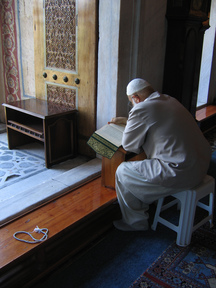
Did the picture you choose to illustrate today's list with suggests that in lack of television people might turn to god? If yes then this is the first time we agree on something.
God or television ?
I'm inclined to say neither...
I wonder what Arnon's answer will be, but I haven't watched television in 2007, besides the occasional glance at the screen, while my kids were taking in their daily dose.
I haven't turned to God this year and I suppose I never will (i.e. in stead of tv )
What DID happen is that in stead of tv I wander round the internet and I have read more books, magazines and newspapers in 2007 than I have done in many preceding years.... If God is part of the media, than YES, I have turned to God otherwise NO !
Dear Ybe
Ever since i strated commenting here i'm trying to say that the ends' means draw too much attention. Why can't we all sit quietly with ourselves? Why do we need all this noise around us? if not television then god, if not god then books, if not books then work, if not work then love affairs. Obviously there's a threat and we need all this noise to cover a message we don't have the capacity to deal with.
My parents are not TV addicts neither, although they like to drive the car. I like TV for movies and information.
@Neria
I think, if you just sit and be quiet for a very long time, in the end you will go mad. Or have you got other experiences?
Jan
i never tried to sit quietly enough time to check it but a good friend of mine did 10 days Vipassana and experienced some horrible moments. Sitting quietly can be to some people a method of breaking defences, while others only improve their defences this way (lifetime meditators).
Have you ever heared about 'white cells'? i think that having a sort of explanation to a surfacing pain might resolve it. i wonder if i ever had such experience, spontaneously (of course, i wish to do it methodically).
i'll have to stop commenting now because Arnon allows me to make only two comments in 24 hrs (and this is already the third). i respect his request. i guess he and others...;)) want me to engage in prolonged silence streches, if not for my own good then for theirs...
The study is about kids, does it apply for adults too?
I do not spend very much time wachting tv but I like to do it, just as reading books/magazines or surfing the internet. Watching tv can be relaxing if you do it for entertainment. Yesterday I watched the first Fred Hache show from 1971. This was an entertaining piece of dutch tv history and I enjoyed it much.
Neria
I don't think people turn to God because they cannot watch television.
Jan T
According to the article in the New Yorker television does not a very good job in providing information compared to books, newspapers, magazines etcetera.
Arnon
Me neither. But i do think the same urge to run away from themselves pushes them to seek for god, or to television, or both.
@Arnon
I agree, also by my own experience. A TV program seems to vaporize into oblivion, whilst the contents of a book seems to stay longer in my mind.
@Neria
I am not sure what you mean with ‘white cells’, but you will have to mail me now (my PC while soon freeze on this daily blog, the same old problem, you know).
I find this article hilarious.
I watched a lot of television when I was young. Preferably repeatingly Disney-cartoons (I bought the DVD's for my elder sister). The last few years I've watched very little to no television, but when I do, I find myself stopping at those so-called "call-in games". They have something relaxing, I think.
I bought myself a television-set when I was 14 because I had troubles sleeping. Today I still have problems sleeping if I don't put some spoken media on (audiobooks, lectures, Curb your Enthusiasm, fairytales,...)
I think speach is a mind-numbing thing.
To arnon
May I ask where Coetzee's praising words (concerning 'The Jewish Messiah') come from?
Google doesn't to the trick.
Pjötr
Coetzee sent the blurb to Penguin with this message:
"Thank you for sending me THE JEWISH MESSIAH by Arnon Grunberg. You are
welcome to use the following quote in publicizing the book:"
Hope this answers all your questions.
Dens
You have interesting preferences. These preferences might change over the years. So there is hope. Excuse me for sounding like your grandfather, but I guess that was the reaction you were looking for.
To Arnon
Perhaps this also explains where the quote on Hisham Matar's book originates from.
Thank you.
Pjötr
I don't know Hisham Matar, but it seems to me that you are not very familiar with the practice of blurbing.
That is nothing to be ashamed of.
What is the practise of blurbing? Is there some kind of agreement between writers like I'll praise yours if you'll praise mine?
Mieke
Not if your name is Cleo Campert.
Mieke
The practice of blurbing means that a publisher sends the galleys to one or more authors in the hope get a blurb. This is especially common in the US, slightly less so in th Netherlands.
Les gestes de l'habitude
The practice was indeed new to me.