2008/02/16 New York
Defeat
Avoid it all costs
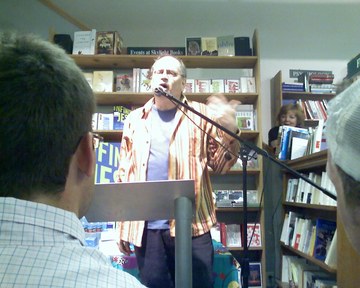
Before the official interview started on Thursday I talked a few minutes with Michael Silverblatt.
He spoke passionately about Thomas Pynchon (an author I have never read) and then explained why he would not mind dying. Most things he cares about had ceased to exist or were in the process of fading away. First and foremost he meant literature, or to be specific, a certain kind of literature. In the words of Michael Silverblatt: something that goes beyond the question how to get a date, in fictional form.
I believe that cultural pessimism should be avoided at all costs. Too often cultural pessimism is just complaints about a career that went south in disguise.
But I think that Michael Silverblatt genuinely felt that the things he cared about were in the process of disappearing.
“How can you still smile?” he asked.
“Well,” I said. “I go to my hotel room and will work a little bit more on my new novel.”
In the taxi to my hotel I realized that Silverblatt might be right, at least from a certain point of view. The enemy is not winning; the enemy has already won.
But I’m not sure if this should be a reason for pessimism. Being defeated is a healthy point of departure.
23 comments
loosing battle
this is the third time in as many months that you remind me of Harper Lee's "To Kill a Mockingbird". Father Atticus teaches his children ( at the end of part 1) "I wanted you to see what real courage is, instead of getting the idea that courage is a man with a gun in his hand. It's when you know you're licked before you begin but you begin anyway and you see it through no matter what. You rarely win, but sometimes you do."
A battle lost, your positive attidude then depends on a belief in a war to be won.
Or your right not to care.
I agree with Michael Silverblatt. From Byron, Dickens, Shakespeare, etc. in the late 19th century to Dan Brown in the beginning of the 21th century. We are a bunch of illiterates.
Arnon
I've never heard such nonsense in my life. There are so many publications seeing the light of day monthly, and as always, alot is crap, but every now and then you can pick up a little gem. What a silly hautain attitude to denounce the total of modern day literature. And even if he would be right, than reread your favorite books of olde tyme. There is nothing wrong with reading your favorite books again and again and again...
@ Joep
I found it telling that Brown sold million of copies and that his books were on the top ten list for more than one year. I felt sickened every time I entered a bookstore that year . That's what the public wants: trash. We were speaking about the public by the way. Of course there are still some brilliant writers.
Joep
As I said in my entry cultural pessimism should be avoided at all costs. And I wholeheartedly sympathized with what Roddy Doyle answered at the 92Y a couple of weeks ago when being asked about declining readership: “Nah, the bookstores are full of people.”
Nevertheless I do understand Michael Silverblatt’s point as well. If let’s say serious fiction is going to compete with what is called popular culture, the defeat (of the serious fiction) is inevitable.
If these categories are useful, and can survive further scrutiny is another question.
And the question is not how many copies are being sold, but what kind of discussion and conversation these books provoke.
Finbarr
It’s just that we don’t live long enough to see the greatest victors turn into losers, wrote Manès Sperber.
But you are right, to continue the fight after you defeat means probably that you believe that there is still a war to be won.
By the way this question (why continue the fight after being defeated more than once) concerned me while writing the Asylum Seeker. The book is not yet available in English, but maybe you can read German, French, Italian or Dutch for that matter.
And thanks for pointing out the article in the Independent.
Mieke
But it very well possible that there was a Dan Brown in the time of Dickens, Shakeapeare and Byron.
I haven't read Dan Brown, so I cannot judge his work but I find the word "sickening" problematic.
Do you think Dan Brown's books should be banned?
Battle
I was defeated many times and yet, I still continue to live, but I do not care no more about winning nor losing. In the end we all lose, we all die. I only want to live my way as much as I can and maybe now I enjoy the fight regardless.
You write, Arnon the way you want to write and I still like it. That is all that counts, and a great support or example for me too.
Yesterday I bought Dostojewski The Demons and the sun was shining and the food was all right.
Mieke
It totally depends on your criteria for literature. Even Grunberg is considered to be pulp by academic standards that ask for complex postmodern - language should refer to language and nothing else- works. I dont agree with those academics, but its all relative.
Mass culture has always won and will always win. Its easy to digest. But I think quality will always survive. Look at the perverted movie industry. Its a mass culture orgy of cheesy movies, but still great independent films are being made and appreciated.
Critsizing culture can also provide a startingpoint for creativity in writing or other arts. In my opinion there is no good reason to think that quality causes quantity.
Why isn't postmodern critisism postmodern? Maybe because than ,we would always stay in this postmodern era. Let's think of another -ism.
No , it isn't the content of the books of Dan Brown that made me feel sick. The ideas he postulates in his books aren't that original. Most of those ideas existed already a long time, at least if you were aware of the existence of the apocryphal texts; So no, it's not to his ideas I object. And even if I did, I still wouldn't be in favor of a ban on his books.
What sickened me was the fact that millions of people bought his books , probably even considered these books to be genuine good -wich they are not-while there are many other books that indeed are worth while reading which never had the attention they deserved. I still feel that ache.
War to be won?
I think there is also the fighting because of the fighting: because of the simple fact that you are in the game.. As show most wars that last beyond the period in which violence is instrumental to reaching a certain goal.
Arnon, I just wanted to drop a "thanks" to you: just saw The Valley of Elah, still hear the powerful sound of the Waltz (end tune ) bouncing in my ears...
Joep
I would say it’s more complex. I consider “Ratatouille” a great movie. It’s hardly an independent movie. And of course it’s difficult to distinguish between so-called independent studios and mainstream Hollywood.
The argument that Hollywood only produces pulp is something I simply don’t buy, based on my experiences.
Nevertheless the movie industry is different from the literature industry, if for no other reasons than that the literature industry is about less money.
Michael Silverblatt’s point is slightly different. It boils down to this: how many readers do you need? For Silverblatt it is unbearable to see what he sees as serious fiction to become a sect.
And now I will stop speaking on his behalf. You can read his article. Just click on the link.
Quality will always survive, maybe, sometimes only after the author passed away. Stendhal sold during his lifetime 200 copies.
By what academic standards is my work considered pulp?
Are there academic standards for literature?
Mieke
When I made this point at the Nexus Conference in 2006 in Amsterdam, a fellow speaker informed me that the thought this argument was a clear example of kitsch.
Nevertheless I think it is important to make this argument from to time.
Maybe it would have been preferable if millions of people had bought my books instead of Dan Brown’s books.
But these people could have used the time they invested in Dan Brown also in fighting their neighbors or reading books why they should fight their neighbors.
That millions of people buy something you consider pulp, for good reasons probably, is not the problem. The problem starts when pulp becomes the standard or when the standard is diluted because of sales figures i.e. economic interests
jan thys and annette
You are both very welcome.
Arnon
Ok, I was slightly exaggerating. Sure there are good mainstream movies. But you shouldnt expect too much from them in terms of realism, experimentalism, originality etc. most of the times.
When I spoke about 'academic standards' I meant the expectations of literaturescientists. They can be very demanding, absurdly demanding even.
And for some critics (o.a. Bart Vervaeck ) your work is considered to be along the lines of simple mainstream writing with nothing much to offer. These are critics that are very fond of the concept of post-modernism. I think you know the type of readers i mean.
I don't agree with this, and I don't think of myseld as an elitsist, but i brought it up to remind Mieke of the spectrum of criteria that one can maintain tiojudge cultural products.
Joep
A good movie is a good movie. What you mean with expectations in terms of realism etcetera is not very clear to me. (I mean I doubt the usefulness of distinguishing between good mainstream movies and good independent movies.) Yes, some critics dislike my work, I’m aware of this fact. The name Bart Vervaeck does not ring a bell, but I trust you completely on this: Mr. Vervaeck does not like my work. Whether the fact that some critics dislike my work should be connected to “academic standards” is doubtful to me.
As it is doubtful to me by the way that the fact that some critics like my work should be connected to academic standards.
Karel van het Reve has written insightful about “academic standards” and literature in a reading he gave many years ago in the Dutch city of Leiden. The text is called The mystery of unreadability (het raadsel der onleesbaarheid). Recommended.
Words as post-modernism and modernism are rarely helpful in a discussion.
For the record: I have nothing against elitism.
Arnon
I just reread 'Het raadsel der onleesbaarheid' in your bloemlezing. I see wat KvhR means, but he also states that the most interesting question is: what makes a good book good and a bad book bad?
This question is not too hard to answer. Again, it depends on your criteria. So there are no absolute standards, which is inherent to the relativity of the terms good and bad. But there are reasonable arguments that can support why a book is considered bad. Do you agree with me on that?
Joep S
A lot has been written about esthetics, I’m not an expert in this field.
Standards are rarely absolute, but it seems to me that if you judge in public, in other words when you pretend that you have a certain authority to judge, it is important to strive for something that goes beyond personal taste and dislikes. This is commonsense, but nevertheless it never hurts to point out the obvious these days.
It’s easier to explain why something is really bad than why something is good. If you undertake the effort to dismiss a certain artwork in public you state also that take you it seriously enough to dismiss it. Maybe you are compelled to do so because other critics rave about it, or it is selling very well, but whatever the motivations were, the result is that you it to a certain degree seriously; even if you ridicule it.
You can look at it from a more sociological point of view; what are the reasons for these critics to take this piece of art seriously? This seems to me a valid point of view as well.
Many people claim that the influence of reviewers has been diminished. This might very well be the case. If it should make us happy is another question.
I don’t believe that there is just one academic standard for literature. Having taught in 2004 at the Elte University in Budapest and in 1998 at City College in Londen (“taught” is a big word, but well) and having had the honor to meet some professors at the Dutch language department of the University of Wroclaw, I feel certain enough to make the claim that there is not just one standard. In general it is healthier for a visiting author to enter the university where he is about to speak as an amateur-sociologist than as an author. I wonder with what kind of opinions and standards the university in Leiden is going to surprise me this fall. But after my experiences in academia – not in the last place my experiences in Wroclaw -- I don’t expect to be flabbergasted again.
Arnon
Thanks for your elaborate answer. I think we are on the same line here.