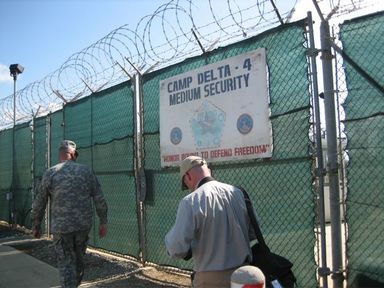
2008/05/07 Naples
Routine
Essential truths
Nicholas D. Kristof is the only NYT columnist who still writes regularly about Guantánamo Bay. In Monday’s International Herald Tribune he remarks: ‘A third powerful new book about Guantánamo, by an American lawyer named Steven Wax, is summed up by its title: "Kafka Comes to America."
The new material suggests two essential truths about Guantánamo:
First, most of the inmates were probably innocent all along, but Pakistanis or Afghans turned them over to America in exchange for large cash rewards. The moment we offered $25,000 rewards for Al Qaeda supporters, any Arab in the region risked being kidnapped and turned over as a terrorism suspect.
Second, torture was routine, especially early on. That's why more than 100 prisoners have died in American custody in Afghanistan, Iraq and Guantánamo.’
Unfortunately compared to the prison facilities at let's say Bagram Airbase Guántanamo Bay might still be a positive exception.
The discussion about Guántanamo Bay is important but it should not stop there.
Why not look at prison facilities in the US proper as well?
18 comments
The prison system has become a very lucrative business, and not only in the US. You can write about it, we can read about it, but too much money is involved and too much people love severe punishments and even torture to stop the system. A lot of people refuse to think about the usefulness of long term imprisonment, torture and the dead penalty.
As I remember a Dutch prison director once said on a VPRO radio program, “Our prison system is mostly useless, but the people like it, so we have to maintain it”
It has become a common business on the free market. (If Hitler had won the war, the concentration camp business would have persisted too, with the huge amounts of money, technology and management abilities involved).
But no reason to keep silent about it.
Difficult subject... What IS the use of imprisonment? Is it an "educational" punishment that is supposed to make the inmate reflect on his wrongdoings and hopefully turn him into a better person? Is it meant to protect people against (potentially) dangerous other people? Is it revenge? Is it the protection of the system/structure of society against individuals who don't play by the rules? Etc. Many aspects of what is thought acceptable may depend on the answers to questions like these. Aren't most views implicitly based on these answers, although the discussion almost never focusses on them?
@Ron
Indeed and the discussion is very delicate in respect to the victims and relatives. Emotions tend to prevail with a more distant and realistic view on the hole system of utopian wars on crime, on drugs, on terror, on sin, etcetera.
(I am much obliged to John Gray)
Your Napels reading
I travelled with pleasure those hours to see and hear you speak. It was a wonderful experience for me and thought the lecture you gave was really interesting. Thanks. I was back in my village at 00.30am. Hope you have a pleasant trip to Rome. I will travel back to Naples tonight and fly home tomorrow morning early. Reading the last pages of the Jewish Messiah in the plane.
Thanks again.
Natasza
P.s. if you ever need a Italian translator, don't hesitate to give me a call ;-)
@ Jan
You are going too fast for me here: do you mean that the attention for the emotions of victims of crimes tends to blur the more societal view on the role of imprisonment in the war on crime, drugs etc? I think I agree, but I don't know if I understood you correctly.
Is a society without prisons conceivable? Any form of organization implies an exclusion of elements, a separation of things, or people, that belong and do not belong to the system. Where do we go with those people? The group's identity is confirmed through negation--those who deny the group are in fact validating it through their subsequent exclusion.
Incidentally, for the first time in 7 months, a 53 year old man was executed yesterday in Georgia for murdering his girlfriend 20 years ago. The execution follows the Supreme Court's ruling of last month that injections are not a cruel execution method.
Capital punishment constitutes the strangest of social contracts. It signifies a point where the government, which in a democracy is a representation of your peers, no longer holds up their end of the deal. Instead of protecting, caring, and leading their subjects, they become their most gruesome mortal enemy. The one you would want to go to for refuge and help has then in fact become your antagonist.
@Ron
You understand correctly.
Furthermore I think the link between the actor of a crime and the victim or his relatives is heavily neglected in our system of punishment. In what we call the more primitive societies, negotiations between actors and victims do play a better part in the retaliation of a criminal act (sometimes for better sometimes for worse, nevertheless).
Our system is more like paying a bill, impersonal and without any connection to the victim.
Indeed in the example of RH CdH the link between actor and victim and even the link between the actors’ criminal act and the actual person - after 20 (!) years - is totally lost.
The (dead) penalty has become a horrendous mechanical act.
Rutger
Is your middle name "Hoogdravend"?
@ Jan
I see merit in a system that uses bills and tickets instead of direct retalliation. For me that's a part of civilization. I sometimes fear our civilization is speeding backwards to the Middle ages. The present trend in papers, newsprograms (like Vijf in het land, but also the RTL and NOS newprograms in the Netherlands) etc. to personalize the news in stead of striving for objectivity and distance, may play a role in the call for more direct retalliation, policticians interfering with the course of justice, popular calls for capital punishment, indifference to Guantanamo Bay and the like. The way a society treats its prisoners is also a measure of its level of civilization I think.
Oscar
No, I just don't have a sense of humor, ask anyone. It's a luxury I cannot afford.
@Oscar
Thank you. That article is very well balanced, intelligent and sensitive, indeed to be recommended.
@Ron
I understand, but the personalization nowadays and is not for the benefit of the victim, nor to maintain a link between actor and victim, nor to look for an acceptable solution or retaliation (maybe this was not the main preoccupation of medieval rulers neither) but to stir up and satisfy a mob of merely spectators, who have most of the time nothing to do with the committed crime, for political reasons only.
I do not want to idealize ancient societies, see the article promoted by Oscar.
It is criminal to keep people in prison without trial and that is a political matter and if not trialed fairly a political crime. ( Guantanamo and elsewhere) If you cannot believe in political justice it disiocates a society. So you earn what you have sewed.
If you treat people as rats in prison you create angry rats when they enter society again.
Some prisoners see their punishment as justice and fair ( no matter how long they have to stay in prison) They know they did something wrong. If the punishment is fair they accept it and learn from it. Some need more lessons.
Prisoners quote you see in all prisons: "If you can't bide the time, don't commit the crime"
But the matter of hospitalisation occurs when sentences are too long. Then it has no use anymore. You get used to live in prison. Life goes on.
Lots of spiritual and loving thoughts , poems and pictures are created in prison. They also translate Arnon Grunberg in prison.
For a few years I have given Buddhist teachings to people on death row. Yes, a lot of creative things become in prison, who has ever argued that those with criminal minds cannot be creative. Crime in itself is the one of the most creative thought patterns. A good crime needs a creative and intelligent mind.
If one is guilty, one should be punished, however even in punishment compassion should be followed. Then again, if one is hold without trial, or innocent, compassion is far to be found. The punisher (government, chosen by society) becomes the one who commits the crime, but then again, it is society in each current time which defines what is a crime and what isn’t. In my view any form of injustice is a crime in itself.
@ Oscar and Jan,
Thanks for pointing at Diamonds' article. Did you ever read his brilliant book "Of guns, germs and steel"? In it he very convincingly tries to identify the circumstances that led to the almost worldwide expansion of "eurasian/european" culture/hegemony/oppression.
prisons
the distribution of finite territory amongst a population follows certain rules. some get a lot of territory, others have to work in order to rent small spaces of it, those who can not "earn" their territory are confined in little spaces - ghettos, prisons, madhouses, or in radical cases, are killed and buried under the ground or cremated. violence amidst the population is strongest where space is scarcest, like in prisons and banlieux.
characters are being formed, some assertive, ready to take, some self destructive - granting themselves little territory, making themselves small, feeling suicidal.
@natasza,
Let's spread compassion and forgiveness for everyone, because everyone has a story and a lot of things happen in a chain reaction.
I agree and I'm sure you had a great spiritual experience in prison.