2010/05/02 New York
Saba al-Bor
The early summer of 2008
In the early summer of 2008 I met lieutenant Matt Gallagher at Base Saba al-Bor.
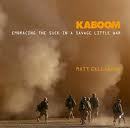
Today, after the panel on war writing Matt Gallagher approached me and gave me his book “Kaboom”.
A happy moment. (Full disclosure: I'm an extra in his book.)
Matt Gallagher is currently living in Brooklyn and we will have coffee one of these days
24 comments
(Kaboom, the once famous Atari 2600 video game…)
What intrigues me is the sentence “And what terrified Matt most were not the terrorists, but the management—and mangers—of the counterinsurgency.”
I would like to read that book.
Arnon
Xilik (Jonathan) told me he gave up on publishing Tirza. If nobody else bought the copyrights I want to buy them (not that I have any money right now but if the novel will prove to be a bestseller I will be able to pay for them retroactively). I want to translate the damn novel for almost three years now, I even spoke with one of the Bavel's editors a couple of months ago. I just left a message on their answering machine because I thought they might have bought the copyrights from Xargol so I'm still waiting for their reply.
Typo
"Galagher" is written with two l's.
Arnon
Does this correspondence has to take place here? Should I email Johannes? You can remove such stuff from the blog.
Neria
I think Johannes is the perfect contact for stuff like this.
from A to Z
Arnon,
Dank u well voor de link, heel leerzam. You used a translation, which can be indeed a kind of literary work. But let me show the distance between a translation and the original text of the Torah with a single example : the tree of the knowledge of good and evil. In the occidental mind-frame it calls back to the myth of Promethee and the main reactions are Why has adam got a death sentence for wanting to know? Isn't that myth designed to detere a rightfull desire of knowledge? In the hebrew it is in fact the tree of the union (like in : and Adam united himself with his wife) between good and evil. Adam mind before the sin was grasping from one to the other and of the universe and he knows about the evil, but in an totally intellectual way. What happened with the the fruit (it wasn't definitively a banana) was that evil became a part of himself. Before this f.e. sexuality was only the technical part of the precept of procreation, after it became mingled with desire and shame. According to the Netsiv, death wasn't a penalty in the contrary it was the only way to ultimatly undo this combination, eternal life (in the same body) should have been a curse.Of course this conditions also the understanding of the unfolding story, not one of damnation but one of free will, reparation and hope. The written Torah in definitively not a novel but a semantic sructure with words functionning as binding sites for the multiple levels of interpretation which constitute the oral torah.
I apologize for this out of context posting, but I didn't have time to answer before Shabos
Groeten
Mieke
Thanks :)
Pjötr
Thanks for pointing it out to me.
To Arnon
You're welcome.
Neria
If I were you , I would translate "the Jewish Messiah " first . It's the perfect novel for Israël.
Mieke
I think that there are some considerations one should keep in mind while thinking about an Israeli readership. I don't think that The Jewish Messiah is the first novel on line to be published right now; one has to develop a tolerance for Arnon's writings. I don't think that the Israeli readership has developed one yet. I guess that to a misogynistic, chauvinistic, racist and militaristic nation, the idea of amputating young women and their Berber boyfriends is more appealing than a 200 pages' description of a disastrous circumcision and talks about Mein Kamf translated to Yiddish. It's an absolute waste of money to go into it. People here are provoked on a daily basis, one should know how much more they can take.
to N. Biala
Aren't you tired of all these stéréotypes about israelis ?
Neria
The basic idea of the Jewish Messiah is that you learn to laugh with stereotypes and clichés.
Mieke + Zipo
Some sorts of humor are culturally based on. Israelis will laugh more easily to Russian and Czech humor than to Arnon's. Humor is not always international. Something in the lack of balance between humor and horror in Arnon's writings makes it legitimate to ask to what extent are these text funny. I think that in a long relationship a common sense of humor develops. Unfortunately, for many reasons, such a relationship has not yet been established between Arnon's novels and the Israeli readership. I believe that such a relation can be built but it should be constructed carefully and that Tirza should be published first.
Zipo - There are several alternative publishing houses in Israel, one for each of Arnon's potential readers. Fifteen I guess. How closely are you familiar with the lists of the weekly sales in Israel? If Yair Lapid's text is on top of the list and Mr. Shalev's lightest text ever is the second then one gets to know what sort of literature the Israeli readership prefers. Arnon's repeated formula can easily be regarded as mainstream to those who are familiar with it; to those who aren't familiar with it such texts can be easily misinterpreted as subversive. I don't want to hurt anybody but these texts are not subversive and there's nothing wrong about it. Provocation is not synonymous to subversives or innovation. And again, not every text should be subversive and/or innovative. It's a matter of decision what sort of gain would one like to get: a misinterpretation of one's text which can falsely boost one's ego temporally or a slow but honest buildup. Also, a false boost to one's ego may turn out to be very expensive; sometimes it worth it and sometimes it's not.
To Arnon
How do you feel about Mieke Dutoits suggestion on how to interpret The Jewish Messiah?
Pjötr
What did Mieke say?
Arnon
That the Jewish Messiah learns you to laugh with stereotypes and clichés and still tells you a compelling story.
Have you x'ed me away?
Mieke
Don't be insecure.
To Arnon
I take the liberty of quoting her: "The basic idea of the Jewish Messiah is that you learn to laugh with stereotypes and clichés. "
Pjötr
And perfect for a country like Israël.
Pjötr
An author is well advised to keep distance from his own work.
Having said this: I’m not sure if my task in life is to teach the readers how to laugh.
Maybe Buster Keaton didn't see it as his task to learn people to laugh, but it was a nice side effect he did.
Neria
Thanks.