2010/12/06 Amsterdam
Foreign power
Concern
Scott Horton writes today on Harpers.org about the judiciary in Spain:
“Diplomats routinely monitor and report on legal cases that affect national interests. These cables show that the U.S. embassy in Madrid had far exceeded this mandate, however, and was actually successfully steering the course of criminal investigations, the selection of judges, and the conduct of prosecutors. Their disclosure has created deep concern about the independence of judges in Spain and the manipulation of the entire criminal justice system by a foreign power.”
I’m afraid that this problem is not limited to Spain.
34 comments
I am afraid you are very right. Power often manipulates.
Public secrets
As Umberto Eco points out, most of the information in the cables was publicly known anyway.
http://www.presseurop.eu/en/content/article/414871-not-such-wicked-leaksOn the other hand, it is one thing to suspect your lover of infedility and another to be confronted with proof. Governments seem to be adept at persuading us to suspend our disbelief. Perhaps we are all suffering from a sort of Stockholm syndrome.
By the way, I am halfway ‘Huid en Haar’. I sympathise a lot with Oberstein and I hope he ends well, although I have no idea how ‘ends well’ could look like. Maybe something, a bubble thing like:
“Oh, yes you know I'm gonna see what I can find,
Just one more trip now, you know I'll stay high
All the time, all the time.”
(Country Joe & The Fish, Bass Strings)
Oberstein,, Hauptstein, Oberststein, I am afraid I am only a simple Stein, an Einstein.
conspiracy theorist
In the past, when one expressed concerns such as the above, one would immediately be labelled a "conspiracy theorist". After all, all the US ever did was to protect democracy and human rights, didn't it. Now, many journalists and politicians (when they're not out calling for the assassination of Julian Assange) dismiss WikiLeaks by saying "there's little news in there," "mostly things we already knew," "mainly gossip." Great fall-back position.
Meester
A conspiracy theorist is somebody who believes that the CIA and the Mossad were behind 9/11.Trying to convince other people to do what you believe is the right thing, isn’t that what democracy is all about?
I'm not sure what to think of Wikileaks. On one hand I think it's a good thing, on the other I find it almost an act of terrorism to throw all information in the open.
…
Whilst reading, a voice in my head kept on saying ‘Arnon has reached adulthood …’. A bit upset, I checked the critics on the internet and, indeed, ‘Huid en Haar’ is called your best ever.
Congratulations and thank you for this gift.
Arnon Grunberg
True, although methods of persuasion may or may not be so "democratic".
Your definition is very specific. I slightly disagree, a "conspiracy theorist" is a label, often applied to those who refuse to buy the saying "never ascribe to malice...".
A very effective label, I think even more so than "anti-Semite".
The FBI does not believe, they imply, that Osama bin Laden was responsible for "9/11". Who am I to disagree with the FBI.
http://www.fbi.gov/wanted/wanted_terrorists/usama-bin-ladenIt probably is rude to blame someone without having the evidence (even the Mossad or the CIA).
There are now "conspiracy theorists" who think WikiLeaks itself is a US government conspiracy. There you have the problem, once critical reflection of government and secret services policies becomes paranoia, there is no end.
If it is, hats off.
(I'm not a conspiracy theorist.)
H Meester
Today (12/7/10) I wrote in the Dutch newspaper “De Volkskrant” that if I would write a novel about WikiLeaks Asssange would be on the payroll of the CIA. Perhaps all novelists are conspiracy theorists. But in reality I’m afraid many conspiracy theorists are anti-Semites.
Secrecy vs transparency
Clay Shirky has written are really well-balanced piece on Wikileaks.
On the tension between the need for secrecy vs transparency:
"As Tom Slee puts it, "Your answer to 'what data should the government make public?' depends not so much on what you think about data, but what you think about the government." My personal view is that there is too much secrecy in the current system, and that a corrective towards transparency is a good idea. I don't, however, believe in total transparency, and even more importantly, I don't think that independent actors who are subject to no checks or balances is a good idea in the long haul.
[...]
I am conflicted about the right balance between the visibility required for counter-democracy and the need for private speech among international actors. Here’s what I’m not conflicted about: When authorities can’t get what they want by working within the law, the right answer is not to work outside the law. The right answer is that they can’t get what they want."
http://www.shirky.com/weblog/2010/12/wikileaks-and-the-long-haul/
Michel
You say it’s balanced. I would say it’s stating the obvious.But a philosopher once told me that philosophy is celebrating the obvious so perhaps we should give Clay Shirky the benefit of the doubt.
Wikileaks make me think about spies. Every country needs spies, but the if the poor spy is caught, the death sentence is waiting for him or her. Maybe Wikileaks is the syndicate for spies.
In Belgium we have Frank Vandenbroucke.
Bernard
Whilst reading I had the same voice in my head: Arnon has reached adulthood.
What pleased me the most , is that Arnon did everything what I asked him to do.
And I too consider 'Huid en Haar' to be his most mature and finest novel.
@Mieke
We are close, indeed.
Bernard
Distant, but close indeed.
Revenge
If one were to take Assange as a model for a character in a novel, making him a CIA operative would be much too predictable and boring.
I am sure there is an element of revenge in his actions. Revenge is a good enough and fairly pure motive. Perhaps in the novel he could have been abused by a filthy Catholic priest. Perhaps he would seek revenge for a miserable childhood in which he was always the outsider, always the "freak".
Revenge is something to kill and die for.
Bringing money into it would make the novel a terrible bore.
Carlos
The novel could be interesting if the greed and the revenge conflict.
Carlos
The capitalist view:
Greed is something to kill and die for...
Sander
If Assange had been into money he would have gone to work at Microsoft, Apple or an anti-virus vendor. Instead he chose to develop free software. And he certainly wouldn't have started a website to kick authorities in the face.
In actual fact, it is interesting to read that Assange's mother went into hiding for several years with him and his half-brother as a result of a custody battle with Assange's stepfather. I am sure he has many reasons to despise the powers that be.
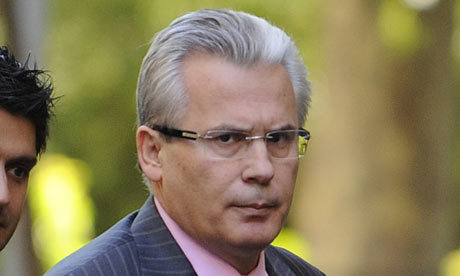
It's funny that in this article Balthasar Gárzon is not mentioned. (In the interview he is). He is spitted out by the establishement and higly supported by Spanish journalists, what makes me belief that he is the last high-level integer judge in Spain. He wanted to investigate and open the discovered graves of the civil war(1936-39). He is accused of opening cases which by law are forbidden. Investigating cases of the civil war are not done in Spain. Ding Dong!
He was one of the judges who went after Pinochet.
Another thing that suprised me in the article is that "Público" is considered as "nationwide competitor" of El Páis. It is not even mentioned in the first five most important newspapers in Spain which are in order : El Páis, El Mundo, El Périodico, La Vanguardia and ABC. I do not know really who Scott Horton is but this info is freely available without needing leaks. (
http://www.elperiodico.com/resources/pdf/8/0/1291325341108.pdf)
Carlos
You believe that somebody on the payroll of the CIA cannot possibly be interested in revenge? You underestimate the CIA and some of its freelancers. To most people money equals revenge. You underestimate the power of money as well.
Arnon
I don't underestimate the power of money at all. But Assange has other motives. This is what scares and angers people like Senators Lieberman and Feinstein.
This does not at all exclude the possibility of Wikileaks being used or that the "secret" cables were leaked deliberately. In fact, this would not surprise me in the least.
In a strange way this real-life plot reminds me of Wim Wenders' "Until the end of the world".
To Arnon
You were once asked on 'De Avonden' whether you considered yourself to be a democrat.
Your answer at the time was: "Dat valt wel mee." If I recall correctly, your reserves were about the discrepance between democracy-theory on the one hand, and how democraties factually function on the other.
Have you changed your thoughts in any way on the matter? If so, do elaborate on the subject.
It seems, that as you engage yourself more with countries where democracy is only a vague, an absent, etc. notion, your tendency to advocate democracy increases.
Or did I completely fail in empathising with your point of view?
Pjötr
Criticizing democracy as we know it is not the same thing as opposing democracy.In the church of democracy I’m a civilized heathen.
Arnon
His points should be obvious, but the obvious is remarkably absent from most commentary and news reports on Wikileaks. Yesterday I was in a discussion with American political scientists, you know, the people formerly known as liberals. Their arguments were exclusively focused the security implications of the leaks for American personnel and related local employees. That, and on the rape charges against Assange, which are completely irrelevant for evaluating Wikileaks.
I also got call from two newspapers and one television program with questions about the "internet war" around wikileaks. The Volkskrant even put the term in its headline for the day. Another obvious point that went missing. Those who promote vandalism to war have surrendered their privilige to be taken seriously.
Michel
Could you explain this sentence: “Those who promote vandalism to war have surrendered their privilige to be taken seriously.”
Arnon
I mean that it should be obvious that this so-called "infowar " or "internet war" -- the attacks against the wikileaks website and the counterattacks from wikileaks sympathizers against other websites -- have nothing to do with war. It is vandalism, nothing more. In fact, it is less costly than most of the vandalism I see in my own neighborhood. To frame this as a war means you are incapable of observing the obvious or you benefit from aggrandizing these events. In the case of the media, the two go together quite nicely.
Michel V
We live in a world of self-aggrandizement; aggrandizing certain events is just a side effect of self-aggrandizement. Do you believe that cyber war can never be labeled “war”?
Arnon
It may be true that we live in an age of self-aggrandizement, and I don't want to deny people the joy of being important, but it is painful to see how, in this case, it leads to the Dutch police arresting a 16 year old kid for participating in the "online attacks". He is looking at the possibility of jail time and hefty fines.
http://nos.nl/artikel/204089-16jarige-bekent-wikileaksaanval.html
Cyberwar
Oh, and indeed, I think there are no such things as cyberwars. There are wars, of the kind with guns and bombs, which may also employ cyberweapons. But there is no cyberwar in any meaningful sense of the word.
Attacks, yes. (Though again, mostly at the level of vandalism.) Espionage, most certainly. War? Not really.
The attacks on Estonia in 2007 are often refered to as cyberwar and have been used as a pretext by NATO to extend their mandate into the area of cyber defense and offense. But these attacks were very small in nature and only succesful in disrupting certain services, because the Estonian infrastructure was poorly developed.
Michel
So what should we do with this kid?
Arnon
'We' as in you and me? Or as in society? Legally, it is an open and shut case. The best he can hope for is leniency in sentencing. I'm not sure what I could do about that. A letter to a newspaper? I've tried to express my concerns to a public prosecutor for cybercrime on Friday. She agreed with me, that this was purely driven by the media attention, which triggered an instruction from the minister to act against these attacks. She even conceded the arrest was disproportional. She also said, however, that these points are now moot. The actions are clearly forbidden by law. This case can only go one way now.