2007/05/09 Lisbon
Poetry in translation
The same?
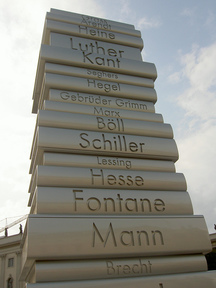
One of my acquaintances alerted me that somewhere in my first novel (Blue Mondays) the main character named Arnon Grunberg stated that Heinrich Heine got on his nerves.
Isn’t it then a bit ironic or hypocritical to use fifteen thousand euro of the Libris Award to subsidize a new translation and publication of a selection of Heine’s poetry and prose, he asked me.
A good question.
Besides the obvious and slightly flippant answer that the main character and its author are not necessarily the same, even if they have the same name, I would argue that a poet who drives you crazy when you are twenty or fifteen, can be appreciated later.
P.S. Excuse me for some small typo’s in the last blogs. The guilt that a single typo causes me can be compared to the guilt a vegetarian feels after eating half a cow.
13 comments
Arnon
How is your kijkcijferkonijn doing?
Please don't excuse for typo's. Many people, such as myself, can't make one descent sentence. When you excuse for your own typo's we will feel like complete idiots.
I disagree Herman, one must always strive for perfection. Especially when addressing a potential Anglo-American audience. Believe me, Anglicists despise language mistakes (and will automatically take you less seriously) but are too polite to tell you. It's called social grace (a concept which is quite alien to the Dutch. ) So it's good, very good, to apologize for you mistakes or, 'typo's'. It means you're aware of them...
Sorry: 'your' mistakes instead of 'you' mistakes ;)
It is true that one's appreciation of an author can change as time goes on.
I remember that my very first response on your blog was to 'In praise of the translator ' where I made a remark on the translation of poetry.
Secondo me - and especially for poetry - a bilingual edition is a gift to the reader: one side the original text, the opposite side the translation. The reader can enjoy the words, sounds and rhythm of the original (if he masters the language of course, if not he can simply limit himself to the translation) and return to and compare with the translation and vice versa. So I enjoy - among others - Rilke, Eliot, Kavafis .....
A delight.
I'm looking forward to Heine.
Heine
I think the idea of a bilingual (German / Dutch) edition of Heine is great; do not forget to include the following fragment:
"Friedliche Gesinnung. Wünsche: bescheidene Hütte, Strohdach, aber gutes Bett, gutes Essen, Milch und Butter, sehr frisch, vor dem Fenster Blumen, vor der Tür einige schöne Bäume, und wenn der liebe Gott mich ganz glücklich machen will, lässt er mich die Freude erleben, daß an diesen Bäumen etwa sechs bis sieben meiner Feinde aufgehängt werden. " (Aphorismen und fragmente. Werke, vol. 4, p. 735.)
If it is true that your father forced your mother to read Heine’s poetry, one does not need to be a psychologist to understand your feelings about Heine now and then.
Sometimes your typo’s provide me with relief for my own incompetence.
So dear Arnon, you are appreciated not only for your excellent works.
tess
You are right about perfection.
And about social grace as well.
I wanted to say something, but the flickering light and shadow in the morning on the face of my daughter distracts me from it.
excuse me
The plural form of typo is written without an apostrophe.
That is the spirit, Hanne V !
Do not ask yourself how science, religion (or in this case, grammar) can serve you.
Ask yourself what you can do for science, religion, etcetera … and you did.
Social grace
Tess, I agree with you that social grace is an alien concept to the Dutch. I learned this concept in meeting foreigners, and when visiting other countries. We, that is, the Dutch, can learn a lot form other cultures.
(I don’t know if you have ever been in China or India, but it is even a worse there)
@ Herman. But at least China and India are booming. In other words, they can get away with it.
I don't agree with the concept of social grace being alien to dutchspeaking people.
But maybe that's because I live in the strange city of Brussels.
When dutchspeaking persons talk french to frenchspeaking persons and vice versa, it is not polite to correct them. It is only accepted when the people you are talking to asked you explicitly to correct them.
I know my english is to tire some of you, and I do apologise.
But I feel the same way when dutch native speakers make mistakes in Dutch and then don't even feel ashamed about it.
Maybe I am to old fashioned in that way, but if you cannnot speak the language in which you where brought up, how will you ever be able to make an argumentation and articulate in a decent way what's on your mind?
So, for the dutchspeaking people I meet in my life, I will seldomly correct them, it's not nice to be corrected in public if you didn't ask for it, but I will form my conclusions about that person.