[ Previous ]   [ Next ]

A small suitcase

Give my regards to Berlin

Shortly before the reading I called my mother. She ended the conversation with the remark: “Give my regards to Berlin.” It was strangely enough the first time that it crossed my mind that mother, who was born in Berlin and lived there the first twelve years of her life, had sentimental feelings for the city.
I find audiences in Berlin compared to audiences in other German cities quite difficult.
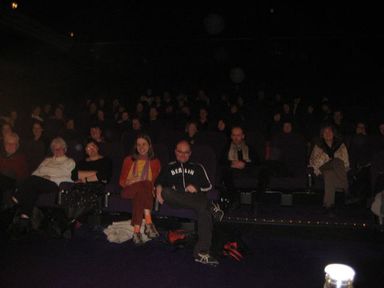
But the theatre where the reading took place, a cinema actually that used to be a brewery, was beautiful and the interviewer modest and interested at the same time.
Above all I appreciated the bookseller, a man who used to sell jewelry from India and who had met his wife, a dentist, while selling her jewelry on the streets of Mainz.
There is something romantic about selling jewelry from a small suitcase on the streets of Mainz. I give this evening an 8.

7 comments Last_comment
Arnon
How does your mother feel about your upcoming trip to Iraq?
Cliches
Mr Grunberg,
After reading your article about the IDF in last Friday's edition of NRC Handelsblad, I was a little disappointed by the fact that none of the female soldiers in combat training that you spoke to got cited in the article. These women are pretty unique in two ways; as you point out in the same article, Israel is the only nation where women get drafted into the army as well as men, and then on top of that these particular women don't have administrative tasks in the army, they train for combat.
Their responses to you got summarized by your statement that 'only cliches came out'. Maybe it would have been nice to let the readers of the NRC hear some of these alleged cliches, to then be followed by your qualification of them.
Now, the result is an article featuring a picture of you with three female soldiers, another one of a whole line of -mostly cute - female soldiers standing guard and on the cover of the magazine a female soldier with a mud mask on her face, but in the whole piece only one female soldier gets quoted, as saying 'We are just as good as men'. I hope this will be somewhat made up for in part II of the IDF article...

Also, now that we're talking about cliches anyway, with regards to your possible visit to the Palistinian territorities; if the answers of these IDF soldiers didn't make it into the article then I hope we can trust you will ensure that opinions voiced by Palestinians that by general standards can be qualified as 'cliches' don't make it into the paper either. I mean; right wing, zionist cliches aren't any worse than left wing, pro-Palestinian cliches, or are they?
Eva van Campen
If you had read my article carefully you would have noticed that the IDF’s minder made conducting interviews hard if not impossible. We don’t know of course if these young soldiers had said something interesting without the presence of the minder.
It’s not my habit to distinguish between rightwing clichés and leftwing clichés or Palestinian clichés and Israeli clichés for that matter– I believe this remark said more about your ideological preoccupations than about my article.
And on what base do you think clichés these young soldiers uttered were right-wing Zionistic?
It sometimes really helps to forget for a second your ideological prejudices while reading. This might prevent you from jumping to conclusions that are false.
If any of the young female soldiers had said something quotable I would have quoted her. “We are as good as men,” is a poignant summarization of the conversation I had with them.
By the way these women train for combat, but they don’t actually do combat.
I can recommend “Men, Women and War” by Martin van Creveld for insightful observations on this matter.
Oscar W
She is not too happy but she will survive.
sense
arnon

it was no co-incidense
that you called her for her sense
its what life ments....
Arnon
Ofcourse when I read an article like yours, at least to a certain extend I read it through the lens of my own ideas and opinions about the topic. ('Prejudices' sounds too much like something coming from ignorance, and I probably don't know nearly as much about Israel and the IDF as you do, but enough to have an opinion not a prejudice) But obviously you have your opinions, and in an article like this one, because of things like the chosen quotes, these definitely show. And that's ok; you are not writing a newsstory for the international pages of the NRC. after all. This is the Culture Section, and I assume your assignment wasn't to present newsfacts in an as neutral as possible way. But in such a long, indepth piece about the IDF, what I miss are at least a few lines about the ideological reasons with which people serve, or that make them serve longer than they have to. And more in general; about the pride many israelis feel in serving and defending their country, even when at the same time they may have mixed feelings about either the army or certain aspects of israeli politics. I think this is another aspect that makes the israeli army unique and different from, for example, the US army where, apart maybe from John McCain's sons, unfortunately a lot of soldiers enlist because they have very few other options in life. And how many dutch soldiers did you meet in Afganistan who would really, and without thinking twice about it, give their life for the Netherlands?
I can hardly imagine that none of the female soldiers you spoke to mentioned sentiments like pride to serve and to protect Israel, and that was what I was getting at in my previous post. I wasn't in the room, but you know what? Maybe it was not just the army official being there, maybe some of their answers were genuinely felt that way.
I will look at Martin van Creveld's book when I have a chance. Although I sure hope it's not one of these books based on the notion that 'men are genetically programmed to... (hunt, usually) and women are genetically programmed to search for grapes and berries close to the cave. And that's why...' etcetera. Too many books like that came out in the past few years. It is just as easy to emphasize the similarities in the capacities of men and women and to back that up with some research as it is to highlight and overemphasize the differences. Unfortunately the latter is in fashion right now.
And last but not least, if you agree with Mr Van Creveld that women can only play an insignificant role in any army, and that they are not going to do combat anyway, then I don't think we need to illustrate an article like this with a picture of women soldiers. In that case, please give me a photo of some nice, tanned, muscular real combat soldiers to look at this Friday....
Eva
First things first: I’m not responsible for the pictures, illustrations, drawings and even headlines added to the articles I write for NRC Handelsblad or any other newspaper or magazine I work for. This is common practice. And this is not to imply that I necessarily disagree with these illustrations or headlines, but it is simply not my responsibility. As a well-informed person you should have known this, at least you should have thought about it.
Yes, one or two of the female soldiers said something like: “We want to fight for our country.” But since these girls were being instructed by a minder, while I was present, what to say or at least what not to say I refused to quote them directly.
I’m not going to quote people who are being intimidated by a minder. Period.
The Israeli army and the Israeli society have changed a lot. There still is an imminent threat compared to let’s say the Netherlands where the Dutch army is fighting in Afghanistan not to protect its homeland but to well, whatever -- or the US army who is fighting thousand and thousands of miles from its homeland as well.
Nevertheless the Israeli elite is turning its back on the army, dodging the draft is not a taboo anymore. Many Israelis, not all of them extreme in their opinions, will no longer describe themselves as Zionists.
You can fight very well without believing in the cause you are fighting for.
As to the gender question, once again I urge you to read Mr. Van Creveld’s book. He is a serious and well-informed thinker.
Last but not least I reject your suggestion that my article about the Israeli army has not been as “neutral as possible.” I won’t enter a discussion whether it’s possible to write neutral articles, I just want to state that I didn’t have any other agenda or any other objective that to write and report about my experiences with the Israeli army and the people I interviewed for my article.
It saddens me that you reach the opposite conclusion that my article was meant to foster an ideology or certain political opinions. I wonder on what facts or arguments this belief is based.