[ Previous ]   [ Next ]

Pink champagne

Shame

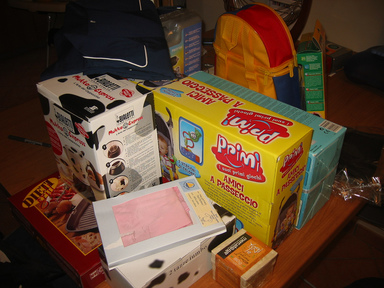
I was invited to a surprise birthday party and I decided to bring a bottle of pink champagne. Maybe not a highly original present, I tend to buy bottles of pink champagne as a present more often, but on the other hand if the birthday boy doesn’t like pink champagne he can always give it to the neighbors.
(It might be weird to some to give pink champagne to a man, but that’s another matter.)
Having arrived in the bar where the surprise party was being held I noticed that, as far I could see, nobody was carrying a present.
Maybe it is not appropriate to bring presents when the party is a surprise.
Anyhow a present can be a burden. I remember birthday parties when I was a kid and the shame one could feel for the present your mother had bought you to give to the birthday boy or girl.
Also I remember a kid coming to my party, giving me his present while saying: “My mother told me, we don’t want to keep this anyhow.”

29 comments Last_comment
The most touching present I once got when I was a teacher was a mackerel head wrapped in a paper giftbox . The six year old boy was so proud to present it and when I saw it he said: "Look teach, pure gold" First I was shocked then moved. I never forgot his name. Jean Paul...... I suppose he became an artist.
every year around christmas time my mother sends me a present for my godfather, which i then bring to him.
Potlatch
"The status is raised not by who has the most resources, but by who distributes the most resources. (...) Prestige increases with the lavishness of the potlatch, the value of the goods given away in it. (...) Such transactions transcend the divisions between the spiritual and the material in a way that according to Mauss is almost "magical". The giver does not merely give an object but also part of himself, for the object is indissolubly tied to the giver: "the objects are never completely separated from the men who exchange them". (...)

"An important notion in Mauss' conceptualisation of gift exchange is what Gregory (1982, 1997) refers to as "inalienability". In a commodity economy there is a strong distinction between objects and persons through the notion of private property. Objects are sold, meaning that the ownership rights are fully transferred to the new owner. The object has thereby become "alienated" from its original owner. In a gift economy, however, the objects that are given are inalienated from the givers; they are "loaned rather than sold and ceded". It is the fact that the identity of the giver is invariably bound up with the object given that causes the gift to have a power which compels the recipient to reciprocate. Because gifts are inalienable they must be returned; the act of giving creates a gift-debt that has to be repaid. Gift exchange therefore leads to a mutual interdependence between giver and receiver.

(From Wikipedia, on "potlatch" and Marcel Mauss)
A time ago some guests always came to our parties empty handed. My friend got upset about it until I told her, “Did you not notice? They think the gift is themselves”.
By the way, a bottle of champagne is my favorite gift too, I am short on inspiration for gifts.
Jakkes. I've got the same childhood memory. Jakkes. I feel shame for it on a regular base.
Rutger
I can only pray for the day that you get a real job.
@ Rutger
That's why I don't like to receive gifts, but I am very keen on giving them.
If a man is ever uneducated enough to feel weird about receiving "pink" champagne, just tell him it's actually "rosé" and show him the receipt - or hit him on the head with it.
Mieke
A job? What kind? Are you offering any? Or, do you prefer to pray for me?
Mieke/Margot
Apologies to both, that one was directed to Margot, obviously.
potlatch

On “potlatch”: in a monetary system, true reciprocity is lost. The symbol “money” does alienate giver and receiver from the transfer itself. The good is symbolized by money, its attachment to a certain human relation, to prestige,… is replaced by an attachment to something purely quantitative – that creates its own rules and its own narrow world, with as a consequence the ambition of givers and receivers of goods is no longer reciprocity (in function of “personal honour”, “prestige”,…) but calculation: how to get as much money as you can from giving as little as possible.
The emergence of money and the alienation from truly reciprocal relations which it brings forth, is an example of something we can see again and again in human reality: the autonomification of the symbol – a symbol reduces meaning and ends up dictating this reduction to the pre-symbolic.
I don’t know if I’m being clear, I kind of have a hang over…
Just googled the word "autonomification" to see if it really exists. It doesn't.
Rutger
One that will keep you too busy to leave comments on this blog.
@Dries
I doubt that google is an accurate dictionary, but in this case it seems to be correct.
@ Margot
I don't think it's to us who should comment onthis blog or not. That I consider Arnons task. But I actually appreciate Rutgers comments, most of the time they are proof of intelligent delicacy, as are Jans.
Dries
Money is an expression of the value of the goods that pass on between giver and receiver. I don't know if it is necessary to have any relationship between the two parties for money and goods to exchange hands. With regard to alienation and production processes, however, I would recommend Walter Benjamin.

There have been so-called potlach wars where entire communities would sacrifice all their resources in order to outdo one another in their gift giving. The gifts themselves were not the point; often, valuable gifts were even destroyed after being received. The gifts bought prestige. Potlatches would sometimes have a disruptive effect on societies; not being able to organize a potlatch would mean having to suffer a loss of prestige.

WIth all that in mind, I would say that Arnon's victory at that party was a complete one. Also, the bottle of pink champagne is a good choice, much better than e.g. a book, dvd, or any other item that lasts. Champagne is expensive, delicate, and at the same time the no. 1 object of this strange desire to waste and destroy a valuable product, as evidenced by sports championships and the shipbuilding industry.
@Mieke, stop and think for a minute please.
@Mieke, you have got to be kidding... why is it that the very man who has shown nasty, in my view even sociopathic, tendencies on this site now suddenly praised as being "oh so sensitive?"
I think I even have an answer for you. Rutger himself was initially scorned and even hated because he kept underlining how gullible and stupid we the people of this blogging community are. Now here's the deal, the reactions to Rutger turned the very moment Arnon's reactions to him turned. initially, Rutger also attacked our host, Arnon, and he was reprimanded by members of the blogging community for doing so. This all changed the moment Arnon started showing some appreciation of Rutgers comments. I'm not sure why he did this, but I'm sensing it has to do with the underdog/outcast mechanism. Whichever way, everyone else followed suit, nobody dared criticize Rutger anymore because now Arnon accepted him and his (initially nasty, however intelligent everyone may find them as being) remarks. The result was (and you don't need to have studied psychology to understand the working of this mechanism) that Rutger slowly but surely started becoming 'nicer' and as you say Mieke, 'sensitive'. At least to Arnon. Subsequently, to everyone else that was nicer to him. ,I don't think I need to underline what this all means, you're smart enough to think for yourself and draw some conclusions.
Wasnt it Rutger himself who spoke in trems of the one and only true master and leader? I wonder who is the one and only true master and leader (to put it in Rutger's terms). The moment Arnon decides to reject Rutger, so will the rest of this community, I'm sure. Is this why Rutger is now doing his utmost to be nice to Arnon - the very man Rutger initially dumped on in every possible way? Ultimately making him, perhaps, as he himself said 'the one and only master'.
No doubt Rutger will claim he has thought about all this, and considered the mechanisms and he will now do his utmost to underline how incredibly stupid I am because that's simply how this very mechanism works. Hell, even Arnon will likely react with irritation. To Arnon I would in return like to have asked in person: for experiment's sake - reverse the psychology for a moment. And then back again, just to see who follows suit and who doesn't. Quite fascinating. Unfortunately, this is now impossible.
Oh and Oscar
Please don't forget to remind Rutger once in a while to take his medicine because me being the only one still critizing him now and then, I 'm afraid he may one day show up on my doorstep.
Mieke
Yes, "I'm coming" is indeed a sign of intelligent delicacy. I hope you have seen the movie "As good as it gets".
Noa
Thank you.
rutger (at least i think it is RHCP???something like that)
The principle of reciprocity which Marcel Mauss has studied, in which the receiver of the gift is obliged to return it (because the gift possesses “mana”, or you could also think of it as prestige of the giver), is abandoned when value becomes abstract – in money.
When money appears, the meaning of goods as possessing “mana”, where a magical balance must be restored in case of an exchange (“magical balance” could maybe be translated as prestige of the owner/giver – getting means being inferior to the giver) disappears. The goal now becomes to acquire money, each man for himself, the good itself is not seen in its own value, but in the abstract value “what can I get for it”. The medium, the symbol, distances itself more and more from what it is supposed to symbolize: the actual value of the thing, the “soul” of the thing. The parties involved in the exchange distance themselves more and more from each other, they are not two men anymore who have things to settle between them, that connection is gone, they both strive for profit, for money, which, as something purely abstract and neutral, stand outside of them. or any commitment

Have hardly read any Benjamin… read one or two of his essays but it gave me a headache, I think, one day I will return to him. One day I also want to read Georg Simmel’s book on money but the price for an English translation is extravagant.
I've tried to understand riots (where people destroy the goods of their own community) as potlatch - but i can't. Competition with other groups is not the point in such riots, although they do spread from city to city.
Dries
Thanks for elaborating, I see better now what you initially were hinting at. Money thus becomes an interface, a social window, like the touch of hands with a handshake. It also becomes an organizing principle, the McGuffin of economics.

Objects already become alienated from their owners when they are sold (rather than "given") because the ownership rights are fully transferred to the new owner. The object has thereby become "alienated" from its original owner. In that sense, money might be regarded as a means to keep us sane, because who could ever keep track of the history of objects and their respective owners? Everybody would be indebted to everybody else.

Meanwhile, what you are saying strikes me as actually very close to Benjamins ideas re: the "aura" of art works.:

"According to Benjamin, this aura inheres not in the object itself but rather in external attributes such as its known line of ownership, its restricted exhibition, its publicized authenticity, or its cultural value. Aura is thus indicative of art's traditional association with primitive, feudal, or bourgeois structures of power and its further association with magic and (religious or secular) ritual. With the advent of art's mechanical reproducibility, and the development of forms of art (such as film) in which there is no actual original, the experience of art could be freed from place and ritual and instead brought under the gaze and control of a mass audience, leading to a shattering of the aura." (http://en.wikipedia.org/wiki/The_Work_of_Art_in_the_Age_of_Its_Technical_Reproducibility)

Still, I doubt if money is completely deprived of "aura" or "mana" when it is no longer exclusive to two parties (as is the case with goods). Has money not become our most secular object of worship? The myth of gold, its purity, malleability, insensitivity for earth, fire, water and air... Money is the quinta essentia, an unresolvable mystery. Money turns everybody into a Parcival, on a quest for the Holy Grail.
Sociopath
For Noa

I am
fifty years
and not
a very nice man.

I have
no wife
no offspring
and
I have
masturbated
a lot.

This is how
I desecrate
the bread.

It
stinks
of me.

I bring
misfortune
wherever
I go.

Maybe
I will come
to you tomorrow
with an axe.

But don't
be afraid
for I
am God.

After Jan Arends
http://klassiekegedichten.net/index.php?id=43
rutger
i'm very interested in this topic. i have no time now but will reply, after some reflection, in probably a few days.
@Rutger, God is always welcome in my home for a beer (and perhaps even some sex for I'd gladly give birth to the Messias), he can bring an axe with him too - as long as he doesn't use it. He's known to use his rod, however. As you're well acquainted with the texts in the Bible, you will know the part where it refers to 'the rod of God'. Even Lucifer is welcome. You can't have one without the other, now can you?
Noa
Before we have sex, I need to know: are you Aliefka from aliefka.com?
@ Noa
If we follow your line of reasoning that we only became more lenient towards Rutger after Arnon somehow himself started to be niecer against Rutger then this is proof of Rutgers statement that we are a sect. Alltough my initial comments were somehow aggressive towards Rutger, it was merely because I liked to provoke him- that's what I tried - , not because I disliked him. So what I try to explain is that I don't consider myself to be a very faithfull pupil of Arnon. I look less in his direction about who I should approve then some other members of this blog and I honestly don't think it's of much concern to Arnon.
@Rutger, yes, as said a few times before here.