2008/07/09 New York
Insomnia
Fourteen months
A good article in the Times about the war that never stops: ‘Before joining the Marines, Mr. Klecker drank and smoked marijuana, but not heavily, said his lawyer, Brockton Hunter. He was once stopped for drinking and driving, but the charge was downgraded to careless driving because his blood-alcohol level was just over the limit.
After Iraq, he shipped out to Okinawa and did what many marines do there: he drank — a lot. But it was not until he left the Marines and returned home to suburban St. Paul that his panic attacks, nightmares and insomnia worsened. So did his drinking. He rarely spoke about the war, and only to other veterans.’
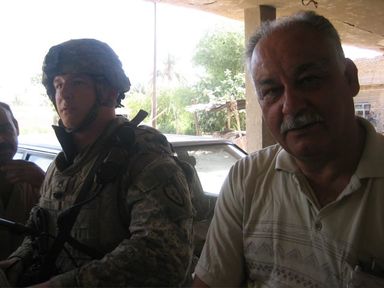
I remember thinking while being on a very small base in Iraq listening involuntarily to some of the phone conversations the enlisted men were making to their families: the front is back home.
This was later confirmed by some of the commanders.
We are psychologists, one of them told me; we know what’s going on back home. We try to help them.
Try to imagine: fourteen months with two weeks R&R, and for many of them it’s not the first tour but the second or third.
12 comments
Arnon,
You're right. It can be a heavy personal struggle to survive after the war.
My dearest, dearest friend survived the Yugoslavian war and became a criminal . After the adrenaline of the war, he found it in maffia comradship and coke. Was completely off the road and ended for 14 years in prison where he was searching for peace and the meaning of life.
Nowadays he is trying to start a "normal " life and struggles to find rest.
This story is the reality. Politicians who start a war have to be aware of this complications that infect peoples' lives, families and generations.
To Arnon Grunberg
When 'De Joodse Messias' came out I walked through 'het Zoniënwoud' with my grandparents who inquired me to know how I related (as a reader) to your work.
I senced that I somewhat alienated from your novels that followed 'De Asielzoeker'.
I'd like to read a war novel of him some day, I suggested. It seems that 'Onze Oom' comes close to this desire.
On a sidenote, are you the right person to address to with a question on Isaak Babel's collected works?
My grandfather and mother survived the war. They rarely speak about it (the only thing I heard obout it was about food and fireworks afterwards), but they don't drink, nor are they criminals (to be). They're just embittered I think.
My brother, a former counsellor of the minister of Social Security & Health, reported years ago about the psycho social problems of veterans of the Yugoslavian war. And these soldiers did not even have to fight, they only witnessed the multiple atrocities. These problems were carefully neglected by politicians, as always. (“Your body and mind are your responsibility, and you nobody forced you to become a soldier - the soldiers are trained and responsible” is often heard in those high circles).
Jan,
Do you agree with that opinion? How psychological aware and well-trained can a young boy of 20 years be , who is indoctrinated by the politicians and his wish to save poor and helpless people in a war environment? What skills do you need to overcome traumatic or even beautiful or very impressing dangerous circumstances? Back in normal , dull life after surviving the shrapnells his mum asks him to make his bed and eat with fork and knife. Isn't that traumatic too.
Pjötr
I wrote about Babel, but I'm by no means an expert. Please ask the question, I'll do my best to help you.
@Helen
Those mentioned opinions in some high circles I consider as idle talk, but nevertheless idle talk dominates.
To repair the damage, the best of our love, care and skills are needed, but remain often inadequate. A idiot can destroy what even a genius is unable to repair.
No wonder people look out for salvation and miracles; I do not blame them.
Jan,
My mother wrote in my poetry-book: Glueklich ist, wer vergisst, wass doch nicht zu aendern ist!. Probably a solution.....
On Babel
As the size of Isaak Babel's work is quite modest, I'd like to have his storys/plays/etc. collected in one volume.
From a column of your's I understood that the publication of such a book in our field of language is out of the question.
Apparently the volume of W. W. Norton & Company (2001) (see
http://www.amazon.com/Complete-Works-Isaac-Babel/dp/0393048462)
contains all his works. To me it is unclear whether his letters (Reports) to his mother are taken up as well.
Or is it wrong to assume that reports and letters are interchangeable words?
I have a second question directly connected to your work. Your name is cited in the latest edition of the bible (Dutch translation) under the category of lecturers (Dutch: lectoren). When I read it last year I wondered what role you played in editing it.
Thank you.
Arnon
Just posted a response to your last comment on The pile - so you may "shoot" me again if you feel like it... ;-)
Pjötr
As far as I know Meulenhoff once did an attempt to publish the collected works of Babel in Dutch including his plays.
If I’m not mistaken recently a collection of his stories based on the Norton-edition was being published in Dutch.
As to the bible, I did comment one some small parts of the new Dutch translation, without being to compare the translation with the original.
Hopefully this was helpful.
annette
I know -- I never shoot people.