2008/10/15 Amsterdam
Daily love
Spider & fly
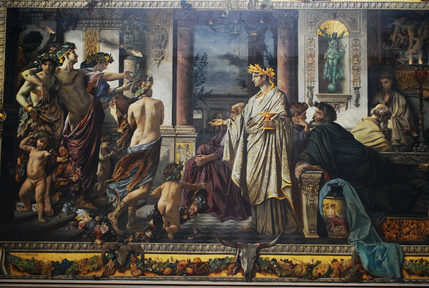
The admission requirement for the course on Plato’s Symposium was: “Write a dialogue between a spider and a fly. Keep in mind that the spider is longing for the fly’s love.”
Yesterday was my last Plato class at Leiden University. (I taught the class together with an acquaintance of mine.) I asked the question: “Did this course teach you something about love, after all Symposium is a text about love?”
Most of the students made clear that Plato’s text had no connection with their love life.
34 comments
Will you be lecturing next year at Wageningen?
No connection
Does this mean the course failed? Or did the students fail the course? In any case, it is interesting that their ideas on love are apparently robust enough to stay outside the grasp of authoritative philosophers.
Michel
My acquaintance Eric Schliesser said yesterday to the students that the lecturers failed, but this could be a didactic technique.
I'm sure that Eric's comment was an attempt to be provocative and make people think harder about their own relation to Plato.
One problem with the question of Plato's influence on one's "love life" is that The Symposium makes a case for a definition of love that encompasses far more than what we would call "love life". If Plato is indeed saying "in the final analysis your love life is not very important, let's talk about something more interesting", then the students' reaction to your question is both apt and understandable.
Anyway, I enjoyed the course. Thank you for giving it.
Victor
I‘m glad you enjoyed the course, so did I by the way.
And I’m pretty sure that Eric’s comment was meant to be didactic, it was probably an ironic comment too, but the question remains: what do we gain by understanding this particular text of Plato better when there is no connection with our lives?
One of the goals of the course was, according to Eric, to teach how to read.
Doesn’t meaningful reading imply more than solving the many riddles and puzzles of the text?
And if Plato’s definition of love (do we know Plato’s definition of love?) does not concur with the students’ definition of love (do we know this definition?) then why use the same word for it i.e. what is this thing that is ‘more interesting’ and is it really ‘more interesting?’
I never suggested that the students’ reactions were not apt or understandable.
Spider & fly
I remember a scène from a long time ago. Once, during my hippie period, I wanted to save a poor fly from the evil claws of a mighty spider, only to realise I crippled the fly and damaged the spider’s web beyond repair. In my mind’s eye, both animals got very angry at me. Me, the creator of a total mess or the interrupter of a relation, if you want.
Some students made clear that their lovelife did have a connection with plato's text. I'm interested in those. Can I meet them?
Love & Plato
I successfully wooed a longtime mate during a Plato course in college. After many years it has finally been buried. I don't regret it but now I can't remember much Plato. We were not two halves seeking to be whole but two spiderflies and might definitely made right.
Hylobates
Nice story. Was he/she a Gibbon too?Are did you look for an other hominoidea?
Dear Strasse,
is your last entry meant for someone specific?
yours,
Eric
Hello out there - is everyone still asleep? Or bored or busy?
@Noa
Ssst. We are still reading Onze Oom (Did you finished it yet?)
By the way, what is your greatest fear: a spider or a mouse creeping towards your private parts?
Dens
I seriously doubt whether my love life has a connection with Plato. Maybe you should find out as we go along to De Nachten? What do you think?
Arnon
I certainly got some insights through our reading of the Symposium, insights that definitely move beyond understanding the riddles and the puzzles of the text. (Though that too is an interesting understanding, since it will allow us to construct deeper, more ironic, more ambiguous and therefore better texts ourselves.) Three things come to mind.
1. The distinction between active formation and giving birth is enlightening and something I want to explore more. On the one hand, there is Promethean (or Baconian) Man, wanting to shape something that is purely and entirely his. This is probably the dominant idea of creation in our age. And other ages: it certainly is the classical idea of God, who shapes the world exactly as he wants. On the other hand, there is the person (much less easy to identify) who is willing for his creation to have a seperate existence and potentially be something new and alien. This is a powerful idea.
2. I came to the conclusion that Plato's idea of beauty - summarised so well in the phrase "niet besmet met menselijk vlees" - is strongly connected to the idea of the eternal. To put it in a Derrida-like phrase: for Plato, Beauty is the absence of Death. I fear there is still a lot of this Platonic conception in us all - and we must get rid of it.
3. For Plato, true love is love of the abstract; the individual is only a way of getting to the abstract. During the course, I called this a "totalitarian" tendency: the love of men changes into a love of mankind, and justifiying the Gulag is only two stes away. I also think it is a betrayal of love. We need to take all those beautiful words and concepts ("love", "beauty", "perfection"), pull them back to Earth and learn to see them within concrete things and persons. In other words, we must combat a tendency to wish to transcend the here-and-now.
What the Symposion has taught me, then, is to see how I am influenced by dubious ideas that lessen my capacity to love. That is surely important.
Victor
Thanks. I regret that you didn’t express this as eloquently as you did now during our last class on Tuesday. But I do understand that it is sometimes easer to write than to talk. I don’t see how your understanding of the text lessens your capacity to love.
And I don’t object to solving puzzles and riddles in a text, all I was saying that it should be a means to another end.
@Bernard - no, I haven't bought it yet. I know I said I was planning to, but I've become a little wary. Judging solely from the description of Onze Oom, I have this feeling that Onze Oom may display a relentlessy hard outlook on humanity. I might have to wait until my son is 18 before I can enjoy the themes in Onze Oom. But you're reading it - you tell me, am I off competely?
Noa
How old is your son now?
@Noa,
What you call ‘a relentlessly hard outlook on humanity’ can be for me ‘a familiar and recognisable vision on humanity’.
I read the book very slowly and I am only a few chapters far.
(I asked about your fear, because Arnon used the image of a spider to depict a woman’s fear.)
Good luck with your son.
Monica
I'm looking forward to it.
@Mieke, 2 and a half.
@Bernard, yes, I understand this aspect of recognition and hence consolation. It's just a personal fase I'm in, that's all.
Spider or mouse? I didn't find the question particularly interesting, nor Arnon's description of a woman's greatest fear. I have lots of mice at home and can't get myself to chase them away or kill them because they're so tiny and cute. And spiders bring luck.
I was scared shitless today though when some big creepy guy who came to fix my boiler decided to sit down and very slowly fill in some forms, while telling me about how his brother died. And that his brother was "sick, you know. In the head." I initially chatted with the man but the look in his eyes gradually glazed over and darted to my breasts a few times. What he was saying was losing coherence by the second. I realized I had to watch my words and movements, very, very carefully. Luckily, a friend called. I hung her up saying "oh yes, sorry I'll be there right now" (which had her confused) and ran out. So THIS my dear men out there, is a woman's greatest fear. A big man with bloodshot eyes, a hard-on and a toolbox creeping towards your private parts.
@Noa
Again, nothing can beat a human. (I like your micro stories, by the way).
Apes
Mieke: I exclusively date H. sapiens, not so much for my own social climbing but for the sake of my future children.
I think Victor was saying not that the class lessened his capacity to love but that it alerted him to tendencies and influences within the world and his life/thinking that, unchecked, would/do lessen his capacity to love, yes? I agree that the drive towards universal love is a pernicious influence making it more difficult to love in our lives. My parents always warned me against my Quaker ancestors that they were people with a great capacity to love mankind and virtually none to love their family. To me it is like an escape by redefinition, that the love of mankind or christ or god is a way of saying "I may have failed by human terms but I'm way ahead of the rest of you in what really matters." The revaluation of the slave as the Other Philosopher would have it.
@Bernard, thank you. There's more of those on my own website if you like. Are you still regularly posting on your own?
Yes
D Hylobates, that is exactly what I meant. The class did not lessen my capacity to love; it allowed me to spot some tendencies in my thinking that might be lessening my capacity to love.
Hylobates
Thanks for your honesty, but I was just teasing you.
About Victor's comment, "beauty is the absence of death", that's something I disagree on. For me, beauty needs to be infected with death. Only then beauty reaches a level of thruthfulness.
Mieke
That beauty is generally conceived of as the absence of death is a massive fact of our culture. Most of us believe that a truly beautiful work of art is a work that is destined for immortality. We think that old people are less beautiful than young people. We buy flowers that are on the verge of opening, not flowers that are wilted and decayed.
Still, there has always been a counter-movement, which asserts precisely what you assert: that only the taint of death is beautiful. The poetry of Baudelaire, the fiction of Poe, everything that falls under the concept of the "gothic" belongs to this counter-movement.
What happens here is that the traditional and dominant values are reversed; but, merely being reversed, they continue to exert their power. I would like to see the concept of beauty thought free of the distinction mortal/immortal altogether.
Victor
You wrote: beauty is the absence of death and you write about the difference between young and older people.
All persons that are young are not equaly beautiful.
I see a lot of older people that are more beautiful than young ones.
Your discription as is, doesn't work...........I suggest you refrase.
Anyway beauty is in the eye of the beholder.
Jeanette
It does help to read Plato's Symposium first before entering this dicussion.
Victor
Apologies for reading too fast.
What are these dubious ideas that lessen your capacity to love?
@Victor
Is that what Plato's symposium says? That pretty much sums up my view on aesthetics. As I often say "the only thing she has rooting for her, is her youth", I'm glad I came up with it without the help of Mr. Plato.
I would agree that it is sometimes hard to see how some classical texts apply to your own life. In the case of Symposium it might have to do with the fact that especially young people have a more romantic conception of love. Romantic love is something that happens to you so it might seem odd nowadays to "manipulate" this by reflection and analysis.
After reading the text and the opinion of Victor, I wonder where the connection with their own life fails: are they not interested in the themes or do they just not agree with the ideas of the author?
The first thing would seem more surprising to me as at least some of the themes should be relevant for everybody: e.g. The relation of love and the need for creation, the relation between physical and more spiritual love, what do we try to obtain with love.
@Jakob
‘what do we try to obtain with love’, is an interesting question.
For me: it is the need to be reassured that ‘the other’ will not disappear; that I will not end up completely alone in the void and vice versa. Of course my love I will fail. And I have a slight idea that a lot of things happen outside my will.